Showing posts with label Namibia. Show all posts

Wednesday, 9 August 2017

African diaries, part 5: Animals galore (in Etosha national park)


Read the previous chapters of this story: 1, 2, 3 and 4.

The day we left Spitzkoppe was probably the hardest and the most boring of the whole trip. I was in the front seat to the right, but there was really, really, really nothing to see. We were to cover 530 km, which is a long distance even on a German motorway, and we were on unpaved roads, and the estimate travel time was nine hours.

I am full of admiration for Dumi, our guide and driver. I just cannot imagine how he managed it. Driving a busload of fussy European tourists for nine hours on unpaved Namibian roads… But to be fair, we weren't fussy. We were patient and disciplined, and when we were given a ten-minute comfort stops – boys to the left, girls to the right – we were back in the bus in ten minutes; and when were we given thirty minutes in a supermarket to get our water and whatever else people wanted, we were back in thirty minutes. We all knew that the drive would take nine hours and were prepared. One of us got motion sick, and although I know it's a horrible thought, I was glad it wasn't me. I had been worried about motion sickness because I get it every now and then, on a scale that few people have witnessed, still less experienced. It's not just throwing up; if it hits me, I am knocked our for days (yes, I have been tested for all kinds of diseases, and nothing was found, so it's just my bad luck). I wear patches for flying, but they make me tired, sleepy, thirsty and disoriented, so I didn't want to wear them during the trip, taking terrible risks. My empathy with the poor motion-sick companion was total, while I was also glad it wasn't me, because a young motion-sick person evokes pity, a old motion-sick lady evokes disgust. Sorry, I couldn't help it. I sat through the day imagining myself motion-sick and wishing I had never come to Africa; so this day was particularly strenuous.

However, the last 100 km before we got to Etosha national park was a good paved road, and by the time we entered the park we were all excited, anticipating to see lots of animals, maybe even a rhino if we had luck. And what did we see less than a minute into the park, at the first waterhole? A rhino!


We only had time for a very short loop, but we saw giraffes, zebras, impala, kudu and jackals, so it was a good ending of a difficult day. And the best was still ahead.

We reached the camp site Okakeujo exactly at sunset, and Dumi kindly allowed us to run to the waterhole without setting up camp first. It is an artificial waterhole into which water is pumped. The horizon was still yellow-orange, and by the water there was a group of elephants, with another one approaching, and they greeted each other politely. There were two small ones. And a herd of giraffes. You could almost not see them in the twilight, but they were reflected in the water, moving slowly and graciously, and I could have watched them forever. 

 
 When Anton took this picture he said I would make it my cover photo on Facebook. Maybe he was joking, but I have.

Because I had just followed the group and had no idea how to get back to our camp lot, I had to go back when others went back. After dinner we went there again. The waterhole is floodlit, and it's magic. First, there was nothing, and then there was a rhino, moving slowly and freezing every now and then. It left, and another came and left, and another… and another. I believe they were several because they were of different size. 

 
This picture shows a smaller one. Imagine one almost twice as big, two huge horns, closer and in perfect profile, white against the dark, its reflection in the water. No picture, but I will never forget it.

I asked Dumi whether we could run quickly to the waterhole before we left in the morning, and there were no animals there, as if there had never been any. Maybe we had dreamed them? 

We drove in loops in the park, mentally adding animals to our catalogue:
      tons of antelopes
      zillions of zebras (and mind, it's zEbra, not zEEbra!)


      giraffes, one with a tiny baby


      kudu
      wildebeest, aka gnu (I think gnu is a better name)
      red hartebeest
      another rhino
      jackals
      secretary birds
      kori bustard (with whom Kory naturally felt particular affinity)
      ostriches
      something that some people thought maybe possibly was a leopard, but the rest of us didn't believe them
      and finally, at the very end of the day, three elephants very close by the roadside.


I was very happy that we got to see elephants so close, because I had seen them like that in South Africa and was eager for Kory and Anton to have this experience.

Dumi would stop whenever we saw anything interesting, and Tabiza gave us fascinating facts about animals. When he couldn't answer a question, he stealthily consulted a book. 

We had lunch at Halali camp, midway through the park. While Tabiza prepared the meal, we were again allowed to go to the waterhole, which was a natural one, with a viewing platform high above it. There wasn't much activity in the middle of the day, but when I went there again after lunch, I saw a group of elephants leaving, so I guess if you stayed long enough you would see a lot. But we had to move on.

In the afternoon we drove out to Etosha pan that I thought was horrible and Anton thought was the highlight of the day. It is a neverending dry surface of salt, possibly as dead as a place can be. 

 
Everybody was fascinated, but I just wanted to get out of there as soon as possible. This picture is supposed to show me dying of thirst, but we didn't stage it very well. 


For the night, we stayed at yet another camp, Namutoni, on the eastern side of the park. Its waterhole was nothing like Okakeujo the day before, and strangely, I felt completely fed up with animals and also very tired. The next morning we drove a final short loop in the park and saw hyenas and a dik-dik, the smallest antelope in Africa, ridiculously small, like a toy. Then we had another long day on the road. 

To be continued. 

Tuesday, 8 August 2017

African diary, part 4: Night sky at Spitzkoppe

Read the first, second and third chapters of this travelogue.

The drive from Swakopmund was only going to take two hours. I had no expectations of this afternoon, other than it would be the only camp without shower.

Side comment: It's nice to have a shower after a long day on the bus, or after a walk on a hot day. But I have no obsessive needs to shower every day. Thinking about how precious water is in all those places – is it really, really necessary to shower every day? I know most people will disagree.

We were going to Spitzkoppe, a weird rock formation in the desert that reminded me of Kata Tjuta in Australia ( a less known, but more spectacular neighbour to Uluru). I don't know whether this place was chosen simply because it was a reasonable overnight spot or whether it is considered a sight in its own right – Lonely Planet says “one of Namibia's most recognisable landmarks”.

I sat in the front that day (we moved clockwise every day, as you do on long bus tours), and after an hour of flat, featureless desert, something triangular appeared at the horizon. I suggested to Anton that this was where we going, but he said it was too near. I pointed out that “Spitz” means spearhead, and this hazy blue cone was as close you could get to a spearhead. It had to be it. Also, I said, it looks near, but it isn't. Indeed, the rock appeared on the left one moment, and on the right next, as the road winded; and it kept growing, as rocks do on an otherwise open horizon, and I started feeling that I would like the place. When we came closer it wasn't just one rock, but a huge group, and we drove right through it to our camp. It was magnificent. 

 
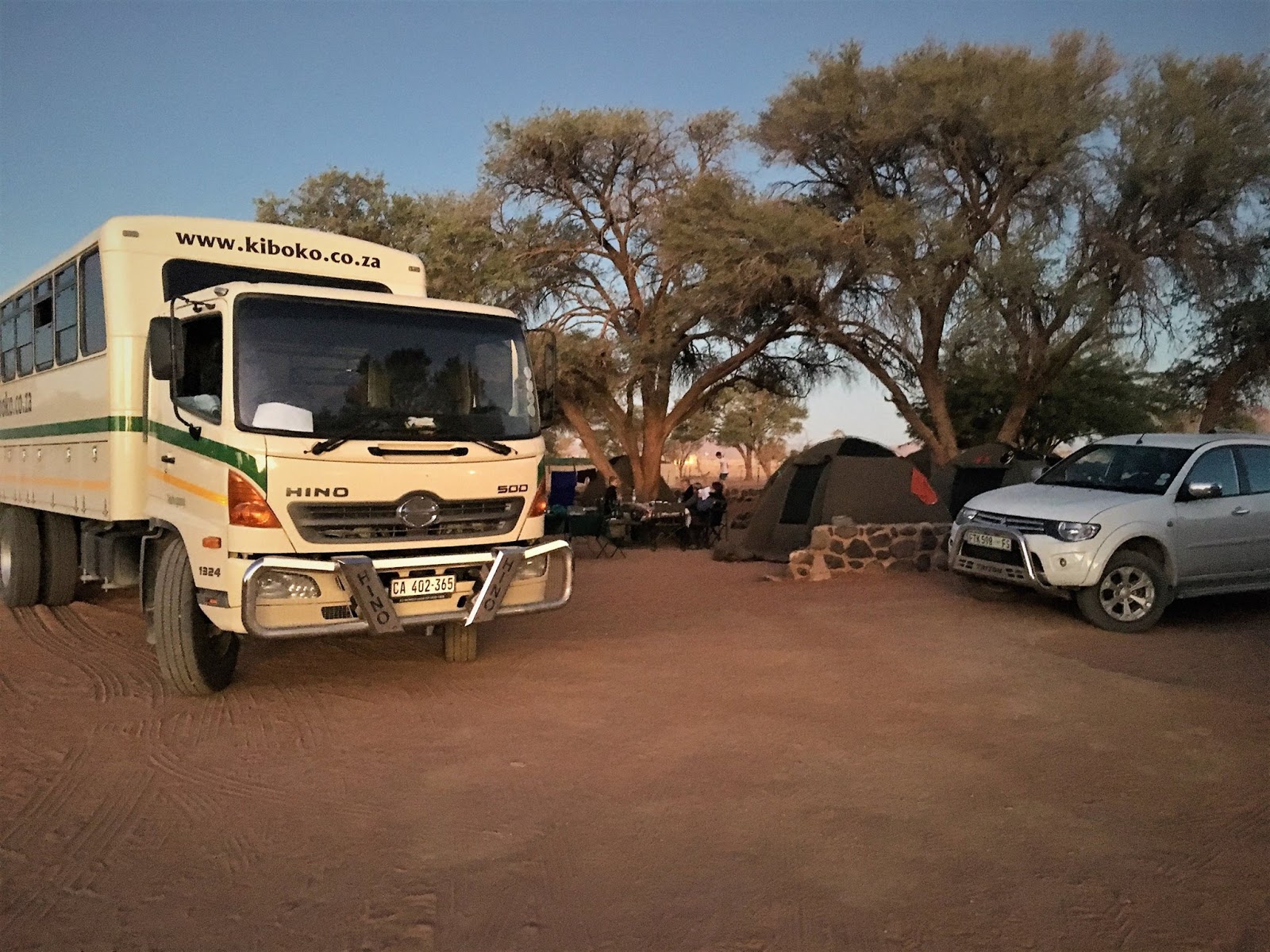
There was an option walk to see cave paintings and meet local people, which I skipped because I just wanted to walk on my own, as it was promised was possible. But it so happened that when the cave painting walk left, there was Anton and Kory and me, and our assistants had started pitching tents so it would have been rude not to help. The tent construction is very clever – of course I hadn't pitched a tent in fifty years so maybe all modern tents are like that. It was completely arbitrary where your tent would be pitched from one day to another, and they all look the same, so I made a point of marking my tent with a towel. You may laugh – but I am an old lady with silly habits. This picture gives you a very good idea of our camping arrangements. The beds were surprisingly comfortable.


Anyway, setting up camp was quick. The scenery was stunning, and the sunset promised to be amazing. Dumi, our fantastic guide, pointed out a dip between two rocks, called The Bridge, and the sun seemed to be setting right there. It is easy to get lost in a desert, so I drew a mental line between the dip and the rock right above the camp – it had some specific features I could rely on, otherwise it can get deceptive since rocks change every minute as the sun is setting. I walked as far as I dared on my own, because I wanted to be sure I would find my way back before it started getting dark. The dip kept moving further and further away, as they do – I stated this earlier about dunes. Finally I climbed a very small rock and watched sunset from there. It felt I was alone on the whole world, in a huge valley surrounded by red rocks. Then I walked back, trying to walk in a straight line toward the rock I had chosen as my beacon. This place was a bonus; I hadn't registered it as a place of interest rather than a overnight stop. I was totally, profoundly happy.

There was fish for dinner, that our chef had bought that very morning at a market in Swakopmund. Fresh fish baked over open fire in a desert – what can be better?

After dinner Anton, Kory and I walked about fifty steps away from the camp and switched off our torches. There it was, the Milky Way, just as I remembered it. I had been worried the previous nights that I couldn't see it, because my vision is getting really poor, and I thought, what if I never ever would be able to see the Southern sky. But apparently it was just too much light before, even in camps, not to mention cities. There it was, the Cross and the Pointers and the Milky Way and the black nothing in the middle of it. It is a miracle every time. And Kory had never seen it before. Friends from the Southern hemisphere, you have no idea how lucky you are to have this incredible sky. It brought back the best memories of Australia, South Africa, Amazonas… I know it sounds pathetically trivial, but it means so much to me. Just as much as the seaside, or maybe more.

Back at the camp, one of the assistants was pointing out constellations using a phone app.

I woke up at five, packed quickly and then sat watching the light emerge and colours on the rocks go from grey to yellow to red, and by seven we hit the road. I would really have liked to stay in this place for one more day. Shower or no shower. 


To be continued. 


Monday, 7 August 2017

African diaries, part 3: Swakopmund by the sea

Read the first and second part of this travelogue.

We were instructed that breakfast would be served at 6, but by that time we were supposed to have packed our luggage and daypacks, bringing them to the truck; rolled up our sleeping bags and brought them to the truck – the opposite side – together with mattresses, and preferably folded the beds and put down the tents. Amazingly, it happened, day after day, like clockwork. I guess people coming on this kind of trip are well disciplined. And of course Dumi and his assistants were outstandingly efficient.

Since I went to bed early, I would wake up at five, and occasionally could enjoy a shower before everybody else, sometimes even a warm shower. All showers and other facilities in all camps were exemplary clean and nice.

From Sesriem we headed north toward Swakopmund on the Atlantic coast. Not quite north, though, because north of Sesriem is just sand dune after sand dune, and the road makes a long loop, almost halfway back to Windhoek. We were to cover 300 km that day, and based on the trip down from Windhoek I prepared for nice scenery to watch. It didn't turn out quite so.

First, we stopped for coffee at a place called appropriately Solitaire. It was a road crossing with a coffee shop in the centre. Now, a solitaire can refer to a diamond, but I think we all associated it with “solitary”. But the coffee was good, and they also sold “the famous Solitaire apple pie”. We all wondered whether apples came from.

The next stop was at the Tropic of Capricorn which was pathetically unremarkable, but of course we all took pictures. 


Then came the endless desert. I like deserts, but it was a particularly deserty desert, with absolutely nothing to look at until we came to Kuiseb Canyon, which was dramatic and a bit scary, with a narrow, steep and winding road with black rock on both sides. 

 
We stopped a couple of times to take pictures and also to look at three quiver trees that for some reason grew there, although they otherwise grow somewhere else. I said they looked like aloe, but Anton didn't believe me. However, I was right. 


Then there was more desert, and still more desert, and it was getting absolutely flat and bare and featureless, just flat and dead all the way to the horizon. It made me tired because there was nothing to look at. My fellow travellers were asleep or listening to music or playing games. I was trying not to think about anything home- or work-related. It was a good exercise.


And then the desert stopped abruptly, and we were in a seaside resort, with palm trees and green shrubs and flowers, and neat houses with gardens – as if we were miraculously transported from Kansas to Oz. We were at Walvis Bay, a harbour town, where we were to have lunch and admire the flamingos. Yes, those famous flamingos from Attenborough films, millions of them. Well, it was wrong season for flamingos, so there were hundreds rather than millions, but it was a miracle being at a waterfront after hours in the desert. You have to believe me that there are flamingos in this picture because they were far away, and we were advised not to go close.

 
Then we hurried on to Swakopmund – again, first a strip of bare desert, and suddenly a green, neat, lovely town which could be a seaside resort anywhere in the world. This was a good reminder of what can be done in the desert as soon as there is fresh water, in this case the Swakop river, which unlike the seasonal Kuiseb – or ephemeral; I love this phrase: an ephemeral river – is permanent and allows a tiny bit of the desert to become a lovely town.

Some people had booked activities: there was a wide choice of sandboarding, hot air balloon, dolphin cruise, camel riding, and more. Anton was tempted by sky diving, but it was far too expensive. I considered camel riding, but Anton reminded me that I was likely to get motion sick, which was the main reason I opted out of dolphin cruise. After my experience with dunes, I also opted out of sandboarding, which I had seriously considered back home. There was also a township walk, but it's not my cup of tea. Eventually, we decided to have a quiet afternoon, walk around in town, and for the evening Anton had booked a table in a fancy restaurant. This was the one and only time during our trip we stayed in a guest house, and it was nice to sleep in a bed for a change. It was also good not to have any activities and digest everything we had already seen and done, which was overwhelming.

We strolled in the town, that had a wealthy, European atmosphere, and many streets still had German names. We went to the beach. I hadn't been at an ocean beach for years, not since Rio de Janeiro, which was six years ago, so I now can add Swakopmund to my mantra of seaside places. Huge waves, and we went on the pier and watched the sunset. It couldn't be better. 


The restaurant was excellent. Back home, when I was reading the guidebook, I checked a famous restaurant in Windhoek, only to discover that it had recently closed down. Which was just as well, because tired as we were after the long flight we would probably not have enjoyed it. But we enjoyed The Tug immensely. Seriously, the best oysters I have ever had. Local fish with calamari and prawns. It was clever of Anton to book the day before because it was full.

I liked Swakopmund so much that I thought I might retire there if I couldn't stay in the UK. We looked at property prices displayed in windows: I would easily afford a nice house. But then of course it's far away; I don't think the grandkids would visit over the weekend as they do in Cambridge. Anyway, it was just a thought.

We had a leisurely start the next day, and again while some other people engaged in activities, we three walked around, bought a headtorch and a towel for me, and attempted to get some cash. The currency situation in Namibia is complicated: the Namibian dollar is tied to South African rand, and both are in circulation, but Dumi had advised us to have a supply of rand because they could also be used in Botswana and Zimbabwe, and there was no guarantee there would be more cash machines anywhere on our route. We didn't need a lot of cash, mostly for water and occasional snacks; but we were running out of what we had taken out in the airport. We went into a bank where there was a long queue, only to learn that we couldn't get rand on our credit cards, but we could take Namibian dollars from a cash machine and then exchange for rand. I don't want to think how much all these operations cost in commissions. It had to be done, and it was done. Until the end of the trip, I hadn't figured out the exchange rates and prices, so eventually I just gave Anton all my cash to dispose of as he saw fit. 
 
After managing our financial matters, we went to café Anton, both for the name and because it was highly recommended in Lonely Planet for its exceptional German bakery. Our final activity in Swakopmund, which I liked more and more and would like to stay longer in, was the aquarium. Frankly, it wasn't much of an aquarium if you have been to some of the good ones, but it had two sharks and some local fish, and it really didn't matter because we were in a lovely town by the sea; but now it was time to move on. 

To be continued.  

Sunday, 6 August 2017

African diaries, part 2: sand dunes

Read the first part of this travelogue here.

The main, if not the only reason I had chosen this trip was the Okavango Delta. As always, Attenborough is to blame, because those fabulous pictures of the delta made an indelible impression, and for many years I had been resentfully telling myself: “Well, this is surely one place you will never see”. So even though I had read the itinerary and the guidebook, the delta was the projected highlight for me, and everything else was a bonus. Sand dunes: fine, I have seen a sand dune in France, yes, it was huge. Game reserve: fine, I have spent a whole week in the Kruger park. Victoria Falls: nice, like Niagara, just bigger. But the Delta – I hadn't seen anything like that.

So when Anton said that the Namibian sand dunes had been his dream for ten years, I was surprised, not to say perplexed.

But let me relate it in correct order. We were picked up at our hotel at Windhoek by the same driver who had picked us up from the airport the day before. It turned out that he would just transport us, and three other travellers, to the meeting place with the rest of the group and the guide, 350 km south-west. The rest of the group – by serendipity or by design, a mix of Swedes and Danes - had already been travelling together for a week, driving all the way up from Cape Town through Kalahari desert.

The road from Windhoek was good, and we had two comfort stops at fuel stations that offered clean, nice facilities with toilet paper. Public toilets have always been a yardstick for me, and the toilets on the way from Windhoek made me feel safe. You could even get decent coffee. We stopped for a picnic lunch at a scenic spot, but otherwise no sights were pointed out, and we were at Sesriem camp some time in the afternoon – I had no clock, and for the coming weeks I lived outside linear time, measuring indefinite chunks between getting up – lunch – dinner – going to bed, which was just what my tired mind needed. I lost count of days; no dates, no days of the week, just Day 1, Day 2 and so on of the trip.

But: back to our first camp. We were as yet uninitiated in the routine and hadn't seen the huge truck that would be more or less our home for the next two weeks. 


The other travellers were pitching tents. Everything was happening very fast because we were going to climb a dune to admire the sunset. I hardly had time to get my bearings. I am not a very good climber, and in the first place, I hate making people wait for me, so as everybody ran up easily on the sliding sand, I just told them to go ahead, I would tackle the effing dune at my own pace. Dumi, our guide, helpfully suggested that for each of us, wherever we got to was the top. I will remember these words of wisdom in other life situations as well. With hills, mountains, rocks and, apparently, dunes, every time you think you are there, you just find another hill, another rock, another dune above. That's me, climbing the dune. Looking at this picture, I feel insignificant.

 
 I missed the sunset, but who cares. It was pretty. I found my way down. 

 
Back at the camp, we had a great meal from the braai, bringing back memories of South Africa, and suddenly it got very cold. The trip notes had warned about cold, and I was glad I had listened, because frankly it felt ridiculous packing a winter jacket when going to Africa. Our fellow travellers confirmed that some nights it had been below zero. 

 
I was exhausted, physically, yes, but also emotionally. Here I was, alone in a tent, in African desert. Last time I had been in a tent was forty-five years ago when I went to an archeological dig. I had a camp bed, a mattress and a sleeping bag. I felt overwhelmed. Anton had generously given me his headtorch (I had discovered that my old one was broken the day before I left home). I put on three layers of clothes and crawled into the sleeping bag. Within five minutes, I was asleep. When I had to go out around midnight, a crescent moon lay leisurely on its back, and first then I felt I was where I wanted to be.

Flashforward: it took me several days to establish a routine for the night. One night, when I needed to go out, I couldn't find the torch and panicked, because it was pitch dark. Then I remembered that I had a torch in my phone, and I knew where my phone was, in the deepest pocket of my backpack. I found the backpack, I found the phone, I switched it on, I switched on the torch. After that, every night as I went to bed, I would lay out on a kerchief, in a strict order: clock, torch, glasses. Clock, torch, glasses.

The order was to sit in the bus at 5.45 because we had to drive an hour to some very special dune that we would climb to see the sunrise. I wonder what local people think about tourists' obsession with sunrises and sunsets. When we lived in San Diego we enjoyed our private sunsets every night for two years and never got tired of them. But otherwise, unless you live by the ocean – or in a desert – you rarely have a chance to watch sunsets, which makes them special. And undeniably, a sunrise over sand dunes is spectacular. 
So, this particular Dune 45, appropriately called because it is 45 km from the camp, is designated for tourists to climb, as, the guidebook informs, it is the most accessible. Dumi had said that yesterday's climb was “easy” so I prepared to skip this one, but it was too tempting. Again, I let the fittest pass me and climbed in my tempo. This was truly a sand dune, just sand with a narrow ridge. Your feet sank in the sand, and I was scared to lose balance. (Anton said afterwards that, unlike a snow slope, in sand you would just fall and stop). I was going to give up every now and then, but persisted, and although I never made it to the top, the reward of the sunrise – not to mention breakfast on return – was great. 


Anton was our designated photographer, so all pictures reflect his point of view. Here is our well deserved after-dune coffee. Note that we are in Africa, wearing winter clothes.


Another ten kilometres further into the dunes, and Dumi promised “an easy, flat walk, maybe with some small dunes” that I was looking forward to, but “easy and flat” is of course relative, as are “small dunes”. Doubtless, as compared to Dune 45, they were just tiny hills. 

 
Eventually the group split, and the brave ones went to climb a REAL dune (second highest in the world!), while Kory and I and some others were told to walk around the dune. Now, “around” is also relative, and finally I realised that there would be a lot more climbing involved, and even the perspective of one of the most iconic views in Namibia, Deadvlei, wasn't tempting enough. I imagined having a heart attack halfway and decided to be sensible. It had also got very, very hot. I walked to the shuttle station and caught a ride back to our bus. Again, I had no idea what the time was and had no one to ask. I sat in the shade with a glorious view of the toilet, with oryx walking around,


until my travel companions started returning – by shuttle as well, since no one had the stamina to walk back. Anton was blissful and said that he was ready to go home. I am sorry I missed Deadvlei as it was apparently stunning. 


After a quick lunch by the bus, we went almost all the way back to the camp, watching all these magnificent dunes, now in full sunshine. We went to see a canyon which was amazing, but of course in a canyon you go down first and then have to climb up; however, it turned out I am a better canyon-climber than dune-climber.


Still I was dead tired by the time we were back in camp. I put the mattress on the floor and lay with my feet up on the bed for a while. But it was good tiredness, and I was soon full of vigour again, and I even helped with preparing dinner. Dumi had said that the trip was “with full service”, but they wouldn't mind if we wanted to help. As a side comment, the food was fabulous all the way through.


Back in the dark solitude of my tent, I had some deep philosophical reflections. Travel is not egoistic. By travelling and feeling happy we increase the general amount of happiness in the world and make it a better place. We share our happiness with other people – as I am doing now. But maybe it is a wrong way to think about it. 

To be continued. 

Here are some more pictures of the sand dunes, to make you happy: 


Saturday, 5 August 2017

African diaries, part 1: Preamble

I haven't blogged for more than a year – not because my life has been totally uneventful, rather the other way round, and I never found time to catch up. But now I have just returned from the best trip ever (says someone who has travelled a lot), and I need not only to share it with friends, but sort and write down my impressions for myself, based on my diary notes, Anton's photos and fragments of memories. I say fragments, because already when I was re-reading my diary halfway through the trip, I noticed that I had forgotten details. There was so much, and such a variety of experience, that it is hard to know where to begin.

So I will begin in the beginning and go on until the end. Then I will stop.

Three years ago, after Madagascar experience, I thought I'd never venture into another long-haul trip, but fortunately strenuous travel is like childbirth: after a while you forget the pain and only remember the joy. About a year ago I saw a picture of the Okavango Delta, and suddenly felt that I was ready for another adventure. I was so much ready for another adventure that I wanted to do it there and then, only of course I need a travel companion, and nobody can go on a long-haul trip at short notice. My sense is always: do things now, what's the point of planning ahead, I may be dead by then; but on the other hand, I may not, and even if it's a year in advance, sooner or later the time will come. (Or not, but then it won't matter).

Anyway, I planted the idea, and Anton and Kory let themselves be persuaded. Kory had never been on a wildlife adventure, but after Anton's pictures and stories from Madagascar she was prepared to give it a try. We investigated various options, and Anton insisted on adding Victoria Falls. I booked the trip and hung it in front of me like a carrot: something to live for, something to look forward to. Eventually, flights had to be arranged, as well as all kinds of other things required for this type of travel, and as it was getting closer it felt less and less real, even though I read the Lonely Planet guidebook for Botswana and Namibia back and forth. Since I had very high expectations before Madagascar and was disappointed, I decided that I wouldn't have any expectations at all, for better and for worse. All I knew was that, unlike Madagascar, we would actually sleep in tents inside national parks, which would hopefully bring us closer to what we were seeking. I didn't want to think about how my back would respond to sleeping in tents; but I exercised every week and walked as much as I could.

Finally one day I had to pack my huge sports bag and my newly purchased backpack, and as I started looking at train timetable, I suddenly remembered carrying this very bag along the tunnels from King's Cross to the Tube, and I decided to go against my habit and take an airport coach. Which turned out to be a serendipitous decision because all trains between Cambridge and London were cancelled that day. Anton and Kory flew from Stockholm to Gatwick (that was my only condition: that we would fly together from London) and transferred to Heathrow, waiting for me and getting more and more nervous as I was stuck on M25, sending anxious texts – even though I, being me, had a wide margin. And then we were on the plane, and I slept peacefully through the night, and we had just about enough time in Johannesburg to run from one gate to the next. We landed in Windhoek, had our pictures taken by a heat-sensitive camera, went through passport control, our luggage didn't get lost, and there was someone to meet us and take us to our hotel. Almost too good to be true.

At that point, Anton and I agreed that we wouldn't compare Namibia to Madagascar, because the comparison wouldn't be fair. Madagascar is one of the poorest countries in the world. Namibia is one of the wealthiest countries in Africa. Of course we couldn't help comparing, and already the very first impressions were different. Windhoek was a modern city, nice and neat, with well-paved streets and traffic lights (Antananarivo, the capital of Madagascar, has a population of two million and not one single traffic light). Windhoek's population is 325,000. On the way from the airport we saw some baboons and an ostrich. The driver took us through the city centre, pointing out landmarks. I felt I liked the place.

We decided to stay awake as long as possible, although we were terribly tired, but the rooms were not ready, and the hotel was far away from the centre, with a courtesy shuttle once an hour. It felt completely unreal to sit there on a patio under palm trees, waiting for the shuttle and drinking guava juice. On the way from the airport I spotted a little street market, which we inspected, but didn't buy anything; we strolled along the main street, dropped into some shops; had a late lunch or early dinner; took the shuttle back to the hotel, and by four in the afternoon we were ready to go to bed.

I had read the itinerary, but I had rather vague idea about where we were going and why.

Digression:

I am so ancient that when I went to school the countries were called South West Africa and Bechuanaland and South Rhodesia. I frequently hear from my British friends that they grew up somewhere in Africa, which the first twenty times sounded like they grew up in Narnia before I realised why it was so common. For them, Africa was a real place. But for me, in Moscow, Africa was totally abstract. It wasn't a high priority in our geography lessons, so the only reason I knew about these countries at all was my father's stamp collection. Otherwise “Africa” was in my childhood a magical country – one, homogeneous country – full of adventure and excitement, featured in numerous children's verses:

Dear children,
don't you ever
go to Africa.
In Africa
there are sharks.
In Africa
there are gorillas.
In Africa
there are big, angry crocodiles
who will bite you,
hit you and hurt you.
Don't you ever
go to Africa. 

 Illustration by Mstislav Dobuzhinsky for Kornei Chukovsky's verse story Barmalei.

Or, in a Russian version of Dr Dolittle, a plea to come and save African baby animals, with a precise address:

We live in Zanzibar,
in Kalahari
and Sahara
where the hippo
walks along the Limpopo.

No wonder my geography was muddled.

Or, from a later date, my son's childhood:

If you walk along a road far enough
you will get to Africa.
In Africa, mountains are sooooo high.
In Africa, skies are sooooo wide.
Crocodiles, hippos,
monkeys, whales
and a green parrot...

Admit that the image of Africa conveyed through Russian children's literature is a bit skewed.

Since then I have been to South Africa three times, so I do have a more realistic view of that part of the world, and I know that the African continent is huge. But I knew very little – still know very little – about Namibia and Botswana. Here I was in Windhoek, a city I hadn't even heard of until we had to get our flights. It felt unreal. And yet it was happening. The next morning we were going on adventure.

I had decided that for the whole duration of the trip I would be off-line.

To be continued.