Showing posts with label family. Show all posts

Friday, 23 December 2022

Annual report 2022


It’s time for the annual report, and I don’t know where to start or how to start. Last year, as the world was slowly emerging from the horrors of covid, we thought that things would get better because they couldn’t possibly get worse. It turned out, they could. I won’t dwell on it too long because there are really no words to describe the pain and the sorrow. My heart is with Ukraine, as well as with my friends in Russia who have lost their jobs and are branded as foreign agents with a real risk of getting arrested any day. My best friend says I will never understand because I am too far away. I am trying. What is inconceivable for me is that so many people who I believed shared my values have chosen the other side. I guess this is how Americans feel about Trump or the British about Brexit. Families are divided, and you lose friends.

I have done my humble share in supporting Ukrainian refugees in Sweden, but of course I could have done more.

The big question when the war broke out was whether to cancel every plan for indefinite future: everything felt pointless, almost sacrilegious. Yet most of us eventually decided that refraining from fun wasn’t the best coping strategy. After all, to be cynical, cancelling a party will not stop the war, and maybe we all needed some fun in the middle of general misery. So my oldest son’s girlfriend celebrated her 50th, and to her – and everybody’s - surprise he proposed to her in front of all the guests. (They married in a quiet ceremony a few months later). My daughter celebrated her 40th with a fancy-dress party. And I celebrated my three-score and ten with a luxury weekend at a countryside manor for family and closest friends. During this memorable event I was introduced to disc golf, which hasn’t become my new favourite pastime, but was a joy to try as an extra entertainment.


Similarly, I saw no reason to cancel travel. It so happened that I made two trips to Denmark, the first to a miniature fair, the second to a miniature summer school. The fair was disappointing, and I am not going there again, but I went with my daughter so we had a nice mother-daughter bonding trip. The summer school was amazing, and I am definitely going again. Excellent instructors, friendly atmosphere and good food. I was very pleased with the two miniatures I made: a 17th-century map book and a Louis XVII desk. I realised how much there is for me to learn.


Obviously, I continued making miniatures and participated in several shows, although I could not attend the main autumn show because I got ill – not covid. 


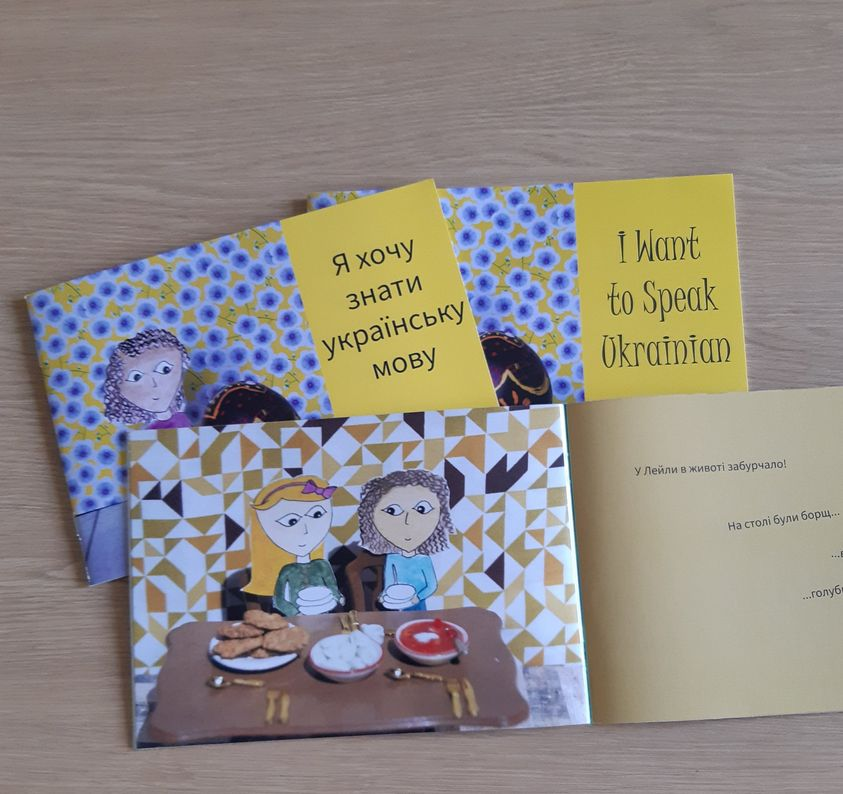
My probably best experience in miniature-making was a commission to make a set of Ukrainian food for a lovely bilingual picturebook. It was quite a challenge. 


Another related achievement was an article published in a dollhouse magazine. It wasn’t the first time, but I felt more proud of it than of my academic publications.


Going back to travel, I fulfilled my grand dream of returning to Camino de Santiago de Compostela, completing the final stretch of 120 km and receiving a pilgrim certificate. Read a full account here. I got to know my fellow pilgrims well, and we are already planning another pilgrimage in the coming year.


I also made a short trip to Gdansk which is a truly amazing city.


I continued leading nature walks during spring, but had to temporarily quit in the autumn because of a foot injury. 


I also continued with my urban walks, based on children’s books, and guess what? I was awarded a very prestigious prize for them! I had thought I was beyond all awards, and it was particularly gratifying to receive acknowledgement for something I was doing right now. The activity is growing, and more and more funding bodies are deciding it’s worth supporting so I am suddenly more involved than I had imagined, for better and for worse. It’s something I strongly believe in.


I also received my second diploma in ikebana, now working on the third and participating in some events apart from my formal lessons.


As I was unable to walk any long distance in summer, I compensated by going wild swimming every morning. 


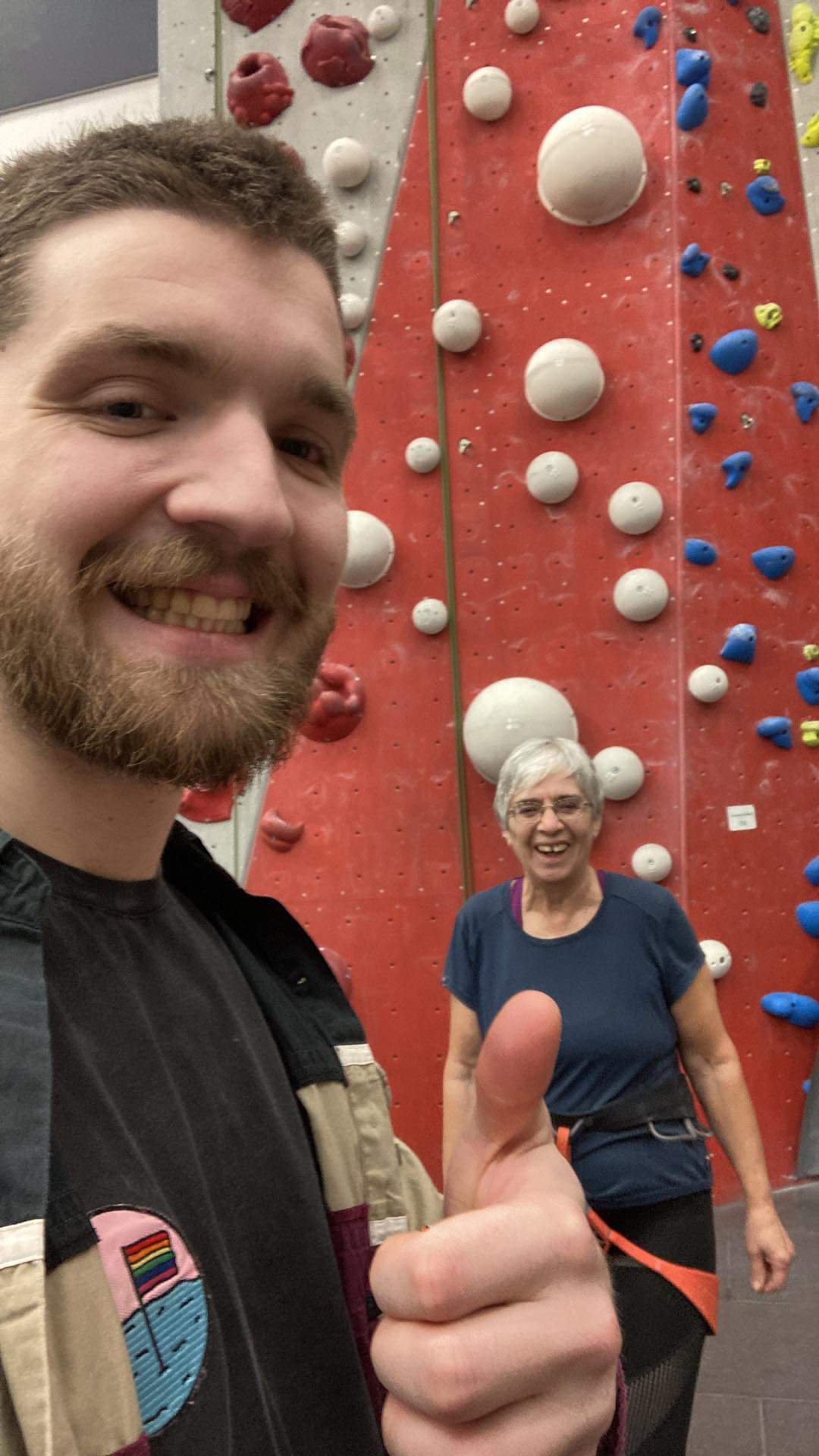
I also did some climbing, not as much as I would have liked to, but my instructor, who happens to be my grandson, is impressed.


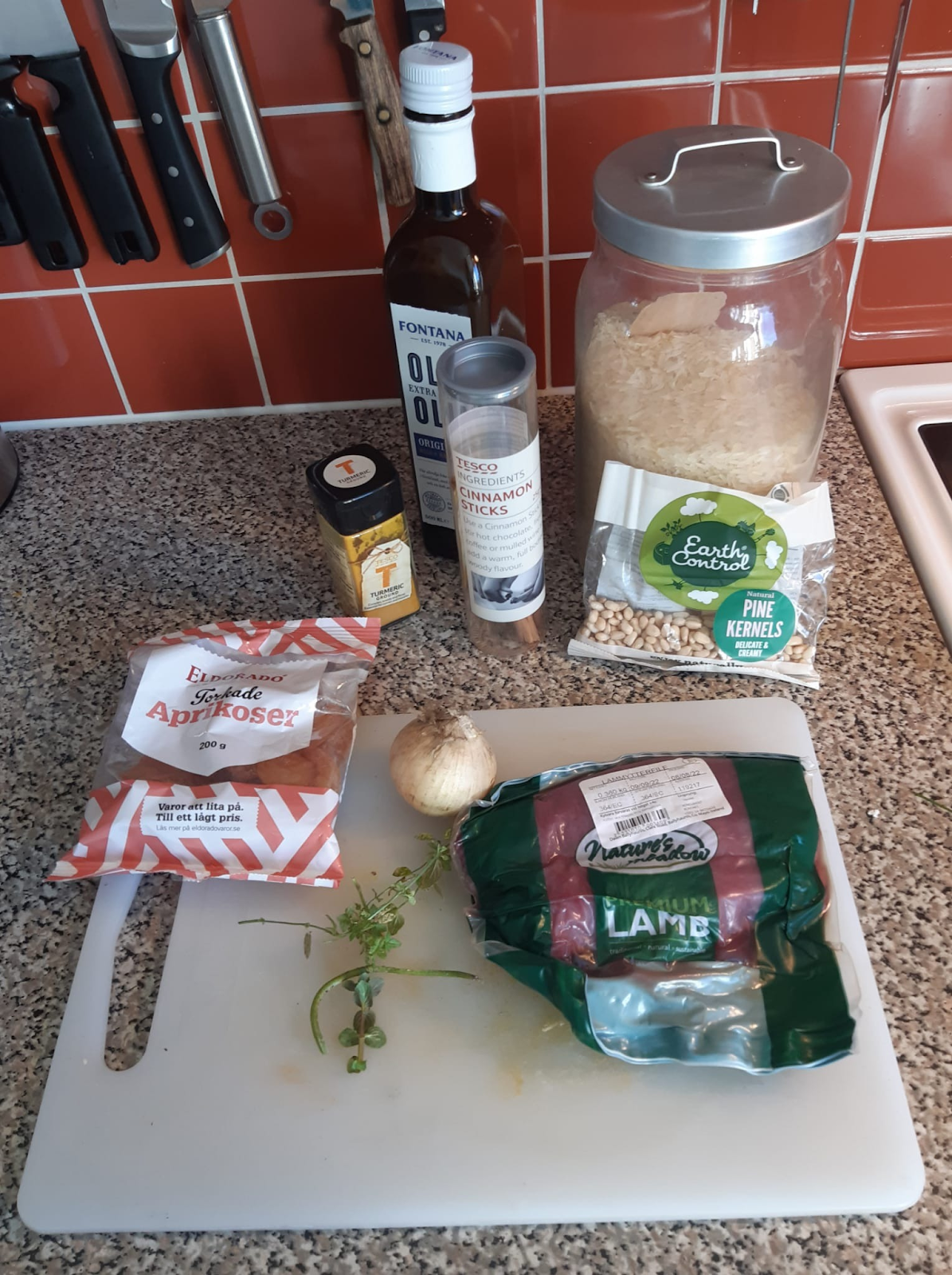
I continued cook-alongs with my Cambridge friend, and in summer we went on a virtual trip with Orient Express, stopping in Paris, Venice, Sofia and Istanbul. We read books, watched movies, listened to music and of course cooked food. Believe me, it’s a great way to stay in touch when you cannot visit in real life. We planned to go to Paris for real, but again I got very ill so sadly it didn’t happen. Maybe next year.


There wasn’t much to do in terms of home improvement, but my wonderful grandsons helped me remove the horrible carpet on the balcony and replace it with a lovely wooden deck. The balcony was once again a source of much joy.


I made substantial progress with Welsh, and I am now halfway through the course. In summer, however, I took a break and learned some Spanish in preparation for my trip to Spain. I actually could say quite a few phrases when I was there.

Like last year, I set a goal of reading thirty books, but I didn’t have any theme so it was a mix of contemporary Swedish and contemporary British, of the latter Ian McEwan’s new novel, Lessons, was probably the strongest impression, alongside French Murial Barbery’s The Elegance of the Hedgehog.

I have been an ardent moviegoer, thanks to my grandson who works in a cinema, but I have also watched numerous films and tv series at home, thanks to all great streaming platforms. The same grandson made sure I didn’t miss any important theatre, opera and ballet performances. Two highlights: Strindberg’s Miss Julie and Brecht’s Life of Galileo. Not to mention all concerts, both my subscription concerts and several on top of those. Occasionally I attended 2-3 events in a week. Quite recently I made a big musical discovery: Ethel Smyth. A good example of the benefits of subscription: I would probably never chosen this concert on my own.

I could go on, but I think I have made my point. It has been a very dark year, and no light any time near. And yet life goes on, and it’s a wonderful life that I wish everyone could enjoy in their retirement, although I am well aware of how privileged I am. Not least thanks to these lovely friends: 


Let's not lose hope! Happy 2023!

Wednesday, 11 April 2018

Too late to change identity


This is a very, very personal story. It took me several days to decide that I want to share it. Stop reading now if you find skeletons in closets disgusting.

Many years ago, my great aunt Margarita, my paternal grandmother's younger sister, came to visit me in Stockholm. It was the first and only time she traveled outside the Soviet Union. I have told her story in a novel and partially in a blog post, so I won't repeat it, and it is only marginally relevant to what I want to tell now.

We were walking in a wood just outside our house, and suddenly, out of the blue, she said: “There is something I need to tell you. You may have heard rumours… They are not true”.

My family has a long tradition of rumours, lies and omissions, secret adoptions and illegitimate children; so I wasn't surprised, but I had no idea what she was talking about. She went on: “I have your granny's and granddad's conversation books from when they were evacuated during the war, and the truth is there”. I still had no idea what she was talking about. My granny lost hearing, ostensibly after childbirth (although with all the lies I am now not sure). During the war they were evacuated from Moscow to a small city on the Volga river, probably sharing a room with several other evacuees. My father was ten years old. Clearly if my grandparents had things to talk about, using notebooks was an appropriate solution. So what did they talk about, I didn't ask. “People said that your granddad could not be your father's father”, Aunt Margarita went on, “because nine months before his birth you granddad was away”. Now, after learning that you are adopted or that one of your parents is not your parent, learning that your granddad whom you loved dearly wasn't your granddad is a huge shock. I wasn't prepared for it. Twenty years earlier I learned that the very same granddad had a second family and a daughter ten years younger than me. It was a shock because it changed my view of him, but as I said things like that weren't unusual in my extended family. I had always wondered about my grandparents' relationship. They never shared a room (but neither did my parents so it was not until I was in my late teens that I learned, from novels, that it was habitual for spouses to share a bed), and granddad always spent summer holidays elsewhere. He also went somewhere every evening – ostensibly to teach evening classes. Somehow, I have always been slow in interpreting obvious facts.

“People said that your granddad could not be your father's father”, continued Aunt Margarita, ”but your granny explains it in the notebooks. She went overdue. She was pregnant for eleven months”.

Now, not even I, naive as I am, could believe this. If Aunt Margarita had never mentioned it, I would have never considered the possibility. My father didn't look much like my granddad, but this didn't justify any doubts. The natural question to follow was: If not granddad, then who…? Did anyone except granny know? Did she know?

It turned out eventually that everybody knew except me. A cousin on my mother's side knew, and that was really none of her business.

Next time I was in Moscow, I asked Aunt Margarita to see the notebooks, and she said she had burned them. This didn't sound credible to me. Why did she have them in the first place? When my grandparents were in evacuation, she was in deportation in Kazakhstan and didn't return to Moscow until 1956. If granny for whatever reason had kept the wartime notebooks, why did she suddenly give them to her sister? And why did Aunt Margarita keep them for more than thirty years only to burn them right after she had tried to persuade me that granny had been pregnant with my father for eleven months? Did those notebooks ever exist at all?

Dismissing the eleven-months-long-pregnancy theory, every piece fell into place. I remember Uncle Andrei well. He was practically part of the family, always with us on holidays, frequently in for tea and dinner. He gave me wonderful presents: toys, clothes, picturebooks, which I didn't of course contemplate then, but that weren't easily available in Russia in the early 1950s. He could get these lovely gifts because he had the privilege of travelling abroad, and he had the privilege because he was accompanist to a very famous violinist. One thing I remember particularly vividly: my teddy's shirt became shabby, and Uncle Andrei made him a new one. I still have the teddy. Every other link has disappeared, the last probably the picturebooks that I had brought to Sweden and that my children eventually tore to pieces. This was before I learned the truth, otherwise I probably would have saved them. Or probably not at all. I am not sentimentally attached to material objects.

I have very few photographs from my childhood, but I do have a picture of myself, aged one, my parents, my grandparents and Uncle Andrei. I had seen this picture scores of time before I learned the truth, but I had no reason to pose any questions. Now of course there is not doubt which of the two older men was the young man's father.

When you are very young, you don't contemplate why some people disappear from your life. I was an extremely shy (or maybe extremely intimidated) child who never asked any questions about anything, not even most innocent questions, so I would have never asked why Uncle Andrei no longer came to visit nor spent summers with us. I do remember, however, meeting him on the landing outside our apartment which was next to the violinist's apartment. He smiled at me, but didn't say anything. He must have been coming to the violinist regularly, but I only met him once.

I have no idea why he suddenly wasn't welcome any more. He had been by granny's side for almost thirty years, her secret, or not so secret lover and her son's father, and my granddad had tolerated it. Something must have happened, and I had no one to ask. Least of all could I ask my father, but he must have known all along and lived with it his whole life. Did he ever meet his biological father after the quarrel? They moved in the same musical circles so it is almost inconceivable that they didn't meet, but did they talk? Were they close at all? Why didn't I ask my father while I still could? Simply because in my family, we didn't talk about such things. All was lies, secrets and pretence.

Now, you may think, does it really matter? Despite his other family, my granddad whose last name I still bear, loved me. He was a fabulous storyteller, and every evening I would come to his room – he was the only family member who had a room of his own – and ask him to tell me a story or draw a picture, which he also was good at. I would sit on his lap. Sometimes he would show me family treasures otherwise locked in his desk drawer: his mother's diamond earrings, war medals, miniature Fabergé eggs, all in lovely boxes with velvet lining. He would tell me about these objects again and again, and I was never tired of them.

He died shortly before I moved to Sweden. I was with him when he died. (Death is very ugly, by the way). He was my granddad.

And yet…

There are interesting family legends on that side. For instance, that our very Russian-sounding last name was adopted by our distant Greek ancestor, Nikolai Stamati. We have traced granddad's ancestry four generations back to a Stepan Nikolajev, so Nikolai Stamati must have been at least a generation above, which takes us to the dark eighteenth century where no records have been preserved in Russia. It seems that granddad's relatives who managed to escape from Russia after 1917 took back the old name, but I haven't been able to find them. Stamati is a common name.

Another legend says that some generations back we were related to the famous Swedish aristocratic family of Oxenstierna, and I still have a brass seal with the Oxenstierna coat of arms, so there must have been some connection. Granddad's mother's maiden name was Reutersköld, which is another Swedish noble family, and while Oxenstierna could be a myth, Reutersköld is a fact. Her mother, my granddad's grandmother, was Victoria Reutersköld, and of all the retained family possessions I value most a silver sugarbowl with the monogram VR.

Neither Stamati nor Reutersköld are part of my ancestry anymore. Nor are the four generations of the Nikolajevs. My name is no longer mine.

Let me introduce myself. My name is Miriam Mitnick. I am Jewish.

I have no Jewish identity whatsoever. My maternal grandmother was Jewish, but she didn't keep any Jewish rituals. I would probably qualify for Israeli citizenship. The overwhelming majority of my parents' and grandparents' friends were Jewish, because they were musicians, artists, scientists, and all were secularised Jews. At least half of my classmates were Jewish, but I didn't learn anything about Jewish culture until my husband started writing a book about Jewish history. (He is not Jewish).

For the past thirty years I have lived with the unconfirmed knowledge of my Jewish grandfather. It didn't make any difference. And it did.

To make a long story short, some time ago my daughter finally persuaded me to do a DNA test. She gave me a DNA test for my birthday. I had been reluctant for a whole number of reasons, but then I thought, what can I lose? (A fourth of my identity, my seal, my sugarbowl, my name, my second cousin twice removed who is the only relative I still keep contact with).

The results have come. I am 45% Ashkenasi Jewish. (I am all sorts of other things, and as I have always known, not a drop of Russian, but that's another story). I have over a thousand DNA relatives in the database, most of them in the USA, and their last names are Cohen, Levine, Shapiro, Friedman and Goldberg. Happy belated Passover, cousins!

It is of course much less of a shock than when I first heard Aunt Margarita's disclaimer. I was prepared for it, and now I know for sure. What shall I do with this certainty? It's too late to change identity and become an observing Jew, not least because I have never been an observing Christian either, and while I have kept family traditions for Christmas and Easter, they have always been precisely that: family traditions. I have been to Israel several times, and I like it, but I don't feel any affinity with the country. I have zillions of Jewish friends, but the reason is that they are my friends, not that they are Jewish.

Maybe the main problem is not embracing Jewishness, but letting go of the other part. Somehow, all these years I have fooled myself into believing that I can keep both. But then, my strongest identity has always come from my German granny's side: traditions, songs, family anecdotes, food recipes. They are still with me. So maybe I am not Miriam Mitnick after all. Maybe I am Maria Tietz.


Saturday, 5 October 2013

Nothing happened...

“You haven't blogged for four weeks”, Staffan points out. He is right. I haven't. When I don't blog for a long time, it can be for two reasons. 1) nothing has happened. This doesn't happen often. 2) far too much has happened. This happens all the time. When it happens I don't know where to start and let still more time pass and more things happen.

With reference to my account of imminent events, the viva went well, but I was so worn out when I came back that I cancelled all travel until Christmas, except Stockholm where I had too many important commitments. The Stockholm trip went fine. Staffan took me to Stansted. I was picked up at Skavsta by my oldest son who “happened” to be in the vicinity (which he has now admitted implies that someone dear to his heart lives close by). He took me to the place where I was staying, which is the International Writers' Guesthouse, in the very centre of the city. It is a small, but comfortable flat with three rooms and shared bathroom and living room-cum kitchen. During the week I stayed there, I saw a glimpse of my neighbours twice.

In the morning, I went down to a cafe for breakfast. It felt weird. The guesthouse didn't have wi-fi, only a USB cable, while I had brought my paddy. But every cafe with self-respect has wi-fi these days. Some of them have “coffee” for password. Then I bought some stuff for future breakfasts and topped up my travelcard. I had a long, pleasurable lunch with a friend, ending in incredible luck in a thrift shop where I found some remarkable dollhouse miniatures and spent more money I would be prepared to spend “at home”. But I wasn't at home, I was travelling, and then you are allowed to spend more. In the evening I went to admire how the youngest and his girlfriend had re-recorated their flat and to taste her famous and fabulous onion soup. The next day was also full of children and grandchildren, and that night I got horrendous neck pain. I often get stiff neck and know how to deal with it, but this was unbearable, and eventually I gave up and went to Emergency. It transpired that I wasn't a resident. “It will be expensive”, said the receptionist. “How expensive?” I asked. She named the fee. “Do I have a choice?” I said. So much for having paid taxes in my own country for twenty-five years. I got painkillers, and my clever daughter made me buy a wheat pillow, which is a bag of wheat that you heat up in a micro and put on your neck. I have now become addicted to it. I sat with it on my neck throughout the conference.

It was a very strange feeling because normally you go away to a conference, and although technically I was away, I also was kind of at home, but not really, since I didn't stay at home, but in a hotel. In the middle of the conference I escaped to attend a family crayfish party which was marvelous and far too noisy. It was also weird to travel back to Cambridge with the students (back home) and with my friend Kin (going away together) who was to stay with me for a couple of days. On top of it, Staffan was going to Stockholm the day after, but I won't go into more detail.

Kin and I had fun together when I wasn't busy with examination boards and crisis team meetings. We did all the necessary sights in Cambridge and around, went to Formal Hall (where I was obliged to say grace, as I happened to be the most senior at table) and even watched a movie. Then the pre-term business hit me: meetings, business lunches, early supervisions, arriving visiting scholars, a row of formal dinners with details I wish I could write about, but I shouldn't. And the next week it finally starts for real: PhD induction on Tuesday, masters induction on Wednesday, academic assessment meetings and meetings about the new Head of Faculty, more supervisions (I have four new PhD students), more formal dinners, various committee meetings, College Council, research seminars – all this in addition to teaching which I, according to my job description, am supposed to do “every now and then”.

Wednesday, 23 May 2012

Object of sentimental value


I am normally not attached to material objects. I have lost so many in the numerous moves that it's just as well to adopt a Moominish attitude: worldly possessions are merely a nuisance. Every now and then I wonder where this or that thing has gone, whether it was just thrown away as garbage, sold for a fortune at Sotheby's or is hidden away in somebody's cupboard. Yet there are some few objects from my childhood that I have very special feelings for. This sugar bowl has been in the family as long as I remember and far beyond. In fact, I have just noticed that there is a stamp on it that says 1883.The bowl was always filled with lump sugar, and there was a pair of tongs in case someone wanted half a lump. The bowl symbolises the stability of home for me, the centrepiece of the tea table around which family and friends would gather. (A Freudian would of course come with any number of interpretations, and a Jungian would add the albedo phase to it. Be my guest). 

When my granny died almost twenty years ago, my mother asked me whether I wanted anything in her memory. Sugar bowl, I said. Fine, said my mother, it's yours, but you will not be able to take it our of the country so let it stay here for a while. For many years I went back to Moscow, to what without granny wasn't my home anymore, and watched the sugar bowl in the centre of the tea table that wasn't any longer the centre of the world. Every time I'd say that I wanted to take the bowl with me, and every time my mother said, not yet. Then I stopped going to Moscow, and the sugar bowl became just one of those many lost objects that are of no value to anyone. Actually, I have no idea, it can be awfully valuable. 

After my mother died two months ago, my son, who is her sole heir, asked me whether I wanted anything from the house. Sugar bowl, I said. My sugar bowl. Yes, I know it's yours, he said, but you won't be able to take it out of the country. It will buzz in security. It sounded familiar so I dropped any further argument, but lo and behold! someone smuggled my sugar bowl from Russia to Sweden, and my dear daugher brought it from Sweden to me. Twenty years later, it is turly mine. 

The funny thing is that you'd think that with such a cherished object I would remember it well. Yet when I unwrapped it, I was shocked to see how much smaller it was than I had remembered. I can imagine that it might look large to me when I was a child, but I did see it repeatedly when I was grown-up, and yet the memory saved the image from childhood. I could also swear that the monogram was Russian BH, for Vera Nikolajeva, my grandfather's aunt. This was the mark on all our family silver. But it is actually Latin VR, which must be Victoria Reutersköld, who was my grandfather's grandmother. From her, the sugar bowl apparently went to her daughter Ernestina, my great-grandmother, who somehow managed to keep it through the wars and revolutions. 

The balance of the world is finally restored. The sugar bowl is once again in the middle of the tea table.


Sunday, 20 May 2012

Report from the celebration marathon, Day 4

See Introduction, Day 1, Day 2, and Day 3

Since I was a good girl and went to bed early I woke up as usual, and Staffan and I and cousin Birgitta had breakfast together. Then Staffan took Birgitta to the railway station and went to do more shopping (that is, making purchases), while I had another cup of coffee with Sergej with the two little girls efficiently preventing us from talking. They were very excited because they were going to a circus that day. I tried to pay for the coffee and soft drinks, but the waiter said it was on the house. Given the bill we had paid, a cup of coffee here or there didn't make much difference, but it was nice of him.

Then we went over to Julia's. They had moved last autumn, and we had not been in their new apartment. It was light and decorated with great taste – not that I had expected anything else. I could tell that there had been some negotiations, but I could also feel that they both love the space they have created together. Some of their common and individual hobbies were tangibly present. I made myself stop being envious. Not envious as I am now, but envious for me thirty years ago. I am in fact happy that my daughter has a room of her own.

Then the guests started coming, and there were hugs and presents and flowers “for the hostess”. Julia had made some canapés and cupcakes, and there was sparkling which I carefully avoided having in mind flying in just a few hours. Most of the friends hadn't seen each other for years, possibly since our farewell party almost four years ago. They obviously enjoyed talking to each other. I kept looking at the clock and trying to figure out how much of the presents I would be able to pack in our already full suitcases. I had to leave behind a huge painting that my sister-in-law had sent, one from Staffan's childhood home. I like it, and it would go well with other art we have, but it will have to be another time.

I had to hint to some friends that we actually had a plane to catch, which they found weird (one friend had sent apologies because she was travelling the day after), but then they know we are weird. We left three bottles of expensive wine to Julia and Pontus since there was no way we could take it with us.

The drive to the airport was painless, and we arrived an hour before check-in even started so we had a light and quite decent dinner. The departure hall brought the memories of four years ago when Julia had taken me to the airport, and all bridges had been burned. I made the memory go away. This time we were returning home.

To be continued. 

My wonderful in-laws Elise and Christian took pictures. 

Report from the celebration marathon, Day 3, part 2


Just before I went upstairs after the fabulous lunch I remembered to check the set-up for dinner, and I am glad I did. I had spent a lot of time on the seating plan. Ten years ago I learned from the lady who was doing my dinner that the object of celebration should by no means sit at the top of the table – which anyone would say was the most appropriate – but in the middle, because then you were just half as far away from both ends than if you were sitting at the top. So I had started there, and I wanted the cousins of matching age to sit together, because they don't meet as often as I would like them to; and I had to place a familiar adult beside the youngest children, and then the usual: alternate gender, don't place spouses together, pay attention to seniority. I had put a lot of thought into it, and it turned out there were two tables. Hence I spent most of the time between lunch and dinner working on a new seating plan. I am sure there is some clever software for this, but I didn't have time to explore. The little time left, I admired my festschrift and checked Facebook for birthday greetings. I know that Facebook prompts friends about birthdays, but you still need to make an effort of clicking on the link and writing “Happy birthday”, and most friends wrote more substantial messages and appended pictures and music. Small tokens of attention, but oh so much joy.

Then I finally put on the outfit I had bought for the occasion.

There was another party in the bar where welcome drinks were served, and I wonder what they thought when all my children and grandchildren started arriving, and there were noisy discussions about who wanted what kind of soft drink and who was old enough to have a taste of the real stuff. Once again, I had said “No presents”, but the kids had warned me that they wouldn't listen to this nonsense. So there were some presents, and there was another big surprise, of which I must tell in detail.

One bunch of grandchildren was discussing what to give granny for her birthday. The five-year-old suggested jewellery, blouse, skirt, scarf, shoes, handbag. The seven-year-old said firmly: “No, Granny wants a smartphone”. They looked at her with doubt, but she was adamant. “Have you forgotten? When we went to visit Granny in England, and she kept looking at the boys' phones and asking what they could do, and she said she wanted maps and star charts and bus timetables”. Isn't she a clever kid? The father consulted his little brother (who had been nagging me for years about a smartphone), and that was decided. Technical support was promised when Julia and Pontus came to visit us the next week. Don't misunderstand me. All the other presents were lovely, each in its own way, but this is such a sweet story.

The rest was more or less predictable, but still wonderful. Even the youngest grandchildren behaved well and enjoyed the special children's meal, and the older ones realised that they could talk to each other live rather than through their phones. The family chorus sang the song that Staffan had written for me, and the two sisters sang “When I am sixty-four” reading the lyrics from their phones. Between main and dessert we asked the waitress to take a family photo. Then we retreated to the bar for postprandials, and the youngest kids started dosing off which the parents completely ignored. And I thought how clever we were to stay at the same place where the dinner was. Because when everybody left we merely had to go upstairs.

To be continued.


Saturday, 19 May 2012

Report from the celebration marathon


Dear Reader, it cannot have escaped your attention that yours truly has just passed the magical threshold. The various stages of celebration went on for almost a week, reminiscent of the famous story of a royal relative sending a belated cable to the Czar of Russia: “For three days running we have been toasting your health”, to which His Majesty replied: “High time you stopped”.

About a year ago when I first started planning my sixtieth, there were many options I considered. One was to bring the whole family over to Cambridge and have a big party including local friends. It probably wouldn't be unreasonably expensive, but the logistics was too complicated. Therefore I asked the family to keep the date open and await further instructions. Ten years ago, for my fiftieth, I had a huge fancy dinner for friends, colleagues and grown-up family members. I couldn't possibly repeat the grandeur of that one, and I also felt that I wanted all the grandchildren to be present. Eventually we decided on a family-only dinner. We considered a stately home outside Stockholm, but again the logistics would be hard, so we found a very special place in town where we had been and knew the food was superb. It turned out they also had rooms.

That done, I started looking around for some form of celebration here in Cambridge. My first thought was that I only had been here for a short time, I didn't have many friends... and then I started counting, and when I got over forty it was pretty clear – apart from the happy realisation that I did have plenty of good friends – that some event was unavoidable. Moreover, it definitely felt a pleasure rather than a duty.

However, I didn't want to have a garden party at home. I've had those, and the house is big enough, but somehow it felt wrong for the occasion. I made some investigations and decided that the Combination Room at Homerton had the necessary ambience and that their catering would be good value. I decided that a Monday afternoon would be suitable, since people might not want to come in on the weekend. My first attempt was discouraging since the catering people demanded room hire double the costs of the reception itself, although I suggested that as a Fellow I might be allowed to use college facilities for free. I emailed a polite “Thank you, I'll look for another option”. Half an hour later they got back saying that the college Bursar had waived room hire.

As I was relating it all to Morag she wondered whether I would accept, as a birthday present from the teaching team, a fancy dinner. That sounded nice. More or less at the same time, Staffan announced that apart from the family dinner on the day, there would be a surprise lunch with two overseas guests who just happened to be in Stockholm. The serendipity wasn't very convincing, but he refused even to hint who the guests might be. I had my guesses, but he wouldn't confirm or deny. I was almost hundred percent sure the mysterious visitors would be from Finland because it was the only reasonable guess, and I thought that perhaps they would offer me an honorary doctorate. Another option might be a festschrift, but I didn't quite believe it.

As I sent out invitations for the reception at Homerton, two people replied with a comment that their birthdays were two days later, on May 16. I had never, ever met anyone with the same birthday as mine so I wrote back pointing this out and suggested that we three born-on-May-16 ladies should go out for a drink together. Which both thought was a brilliant idea, and we even managed to find a date, after a Faculty meeting the week before.

Meanwhile, my thoughtful daughter Julia wondered whether I seriously considered ignoring all friends in Stockholm and volunteered to do a reception for me which was a very noble action. She immediately created a Facebook event, and the two Facebook-passive friends also received invitations by email. Most of them responded at once and were delighted.

Thus the celebration was to continue over a week: drink with born-on-May-16 ladies on Thursday, Homerton reception on Monday, flight to Sweden on Tuesday, surprise lunch and family dinner on Wednesday, reception on Thursday, back to Cambridge on Thursday evening, and a dinner with close friends on Friday. For each occasion, I very strictly specified: no presents, no flowers, although I was sure at least some people would go against my wish or simply fail to read the instructions. As the date approached, I was torn between happy apprehension and horror. Some days I wished I had decided to disappear to an undisclosed destination.

To be continued.

Saturday, 12 May 2012

Interesting facts from individual Russian history, part 3


The final part of the story of my Grossmama Maria (part 1 and part 2)

For the rest of the world, the second World War started in 1939. In the Soviet Union, it started on June 22, 1941 and was called the Great Patriotic War. Within a couple of weeks, all Germans in every city, town and villages in Russia were told that they would be deported. They were told it was for their own protection and that they would be able to come back once the war was over. Jonathan and Maria lived in a German village in the Caucasus, together with a huge group of relatives, nephews and their families. They were herded together and taken by a freight boat across the Caspian Sea, and from there they were to go by railway. They knew that they were going into death. But they did not despair. The family chronicle says that they sat on deck in rain and storm, like cattle, and suddenly one of the nephews said: "Uncle Jonathan, can you please sing something?" And Jonathan stood up and sand Mephistopheles' aria, which was his special hit.

Then they were put in the infamous cattle car to be transported further eastward. But Jonathan got very sick and had to be carried into the car. Three days later he died and was buried in a mass grave at a little railway station, together with others who had died on the way. Many, many years later we put a memorial plaque on our family grave in the German Cemetery in Moscow.

The family was forced to go on. They were dumped off in a tiny village in Northern Kazakhstan and put up to live in local people's homes. Soon first all men and then all able women and young girls were taken away to forced labour. It was called, in true Orwellian spirit, called "Labour Army". 
 
Maria was the only one left of the family, but there were some other old Germans with her. Some of those were artisans and made it somehow. Maria was sixty, but healthy and strong. She went to the boss of the collective farm and asked for work. Her first job was to pile dried cow dung. They heated houses with cow dung because there was no wood in the steppe. In that way she made some wages and got a little flour. The boss liked Maria and invited her to work in a nursery school. It was good, the kids liked her, the mothers liked her because she never stole bread from the kids and shared equally between them all. Most nurses stole food from the kids since the nursery was relatively well-supplied.

Some years later Maria's youngest daughter, who had also been deported and survived the horrors of “Labour Army”, found her way to her mother. All in all, they stayed fifteen years in Kazakhstan. At the end of the war all Germans expected to be allowed to go home, as they had been promised. But there came an official to the village and read a paper for the Germans. It said that all persons of German nationality who had been deported in 1941 according to the special decree of the Supreme Soviet were to live at their places of deportation "for ever" - this was the first time they heard the words: "For ever". Every attempt at escape was to be punished by twenty five years of labour camp. This was also a new word. Anyone who helped Germans to escape was to be punished by five years of prison.

Then in 1953 Stalin died. Three years later all Germans were summoned to the police and received their ID-cards. Clean cards too, no stamps, no indication of deportation. The deported Germans had shown in practice that they were good Soviet citizens, was the verdict. And they had indeed. They worked as hard an anyone just to show that they were Soviet citizens. No matter good or bad, Soviet was it. There were even Germans who wanted to join the Communist party to show how they liked the authorities. The same authorities who had driven them away from their home and let them die in the steppe.

Anyway, the Germans were allowed to live where they wished, but not where they had lived before the deportation. In that way the authorities tried to avoid that the Germans would claim back their houses, schools and churches. They had no property rights. Still some of them moved back to Caucasus. They were not allowed to live where they had lived before, bit they still wanted to live near the places their forefathers had lived. They came one after another, bought houses in old German villages, got jobs. During the '60s, we would often go and visit granny's cousins in Pyatigorsk.

But the majority stayed in Kazakhstan. They had nowhere to go. Some moved to towns, others stayed in the country and went on as peasants. They were diligent and hard-working, they had saved money, built solid stone houses, worked their land, become well-off. They did not want to leave all that once again. Instead, they started schools, libraries, theatres and choirs. This is what our recent visitors fromKazakhstan referred to.

Since my Grossmama Maria was deported from Caucasus she was allowed to come and live with her daughter, my granny, in Moscow. I remember her well. In 1958 we celebrated her eightieth birthday with a huge family gathering. She spoke, read and sang to me in German. Sometimes I was horrendously nasty and rude to her, and I am still ashamed to think about it. She was the nicest, kindest person in the world.

She was the last of her generation, and everybody came to us, to her, on the forbidden Christmas Eve, but I have already told this story.

She died on May 11, 1962, when I was ten and didn't understand death. Perhaps because of that I cannot say that I miss her, in the same way I miss my granny. But I have warm memories of her. 


Interesting facts from individual Russian history, part 2


Here continues the story of my Grossmama Maria

Jonathan and Maria were rich and happy and generous. Jonathan gave money to schools, libraries, hospitals and a prison. He was just about to buy a whole street in Moscow and turn it into an artists' colony.

Then came the Great War, and it wasn't popular to be a German in Russia during the war. He was treated with suspicion. But they didn't take away his property. That came later. According to the family chronicle, when they confiscated all his millions, he said: "What a relief, they were such a nuisance!" For obvious reasons he had not read the Moomin stories, but this was a very Moominish comment.

The one who wasn't happy was Elly who had dreamed of going to Paris to study music at the Conservatory. But there was nothing she could do about it. So when she was old enough she went to Moscow, but that is another story.

Back to Jonathan and Maria. The post-war time in Northern Caucasus was long and confusing. The rulers changed all the time. One day the white army came and forced all high school boys and all other young boys to join them. Next day the red army came and hung and shot people without asking questions. Eventually the Soviet power was established, and Jonathan and his family were evicted from their house. (The house was later turned into an old people's home. When I visited it in 1991 it was being renovated).

The family left the town for a nearby village where they lived with a distant relative. First they lived by selling their belongings. Then Jonathan got some jobs. From time to time there came orders from the new government in Moscow to shoot the ten topmost citizens in the town. This was part of the Great Terror, and the purpose was to hold people in constant fear. There were orders that ten richest and most prominent citizens should get shot, and Jonathan had been one of the richest and most prominent. But someone would come late at night and say: "Uncle Jonathan, tonight we must come and arrest you and shoot you. If we don't do it, they'll shoot us. Get away and hide for a while". So he did. He became a school inspector, then he worked at a wool factory buying wool. Then someone squealed on him. Without any reason Jonathan was accused of being a "saboteur" and "an enemy of the Soviet state", they said that he had stolen state money. He was tried and sentenced to a year in prison, which was a very mild punishment at that time. So he went to the very same prison which he himself once had built.

When Jonathan was released he moved to a little village where he was offered a job as an organist in a little German church. He was the only educated person in the village, and he started a choir, an orchestra and an amateur theatre there. Then he became a school teacher. The children had already left their home and moved to Moscow to study. The first grandchild (that is, my father) was born in 1931. Maria and Jonathan loved their little grandson who would stay with them during summers. There was nothing like the wealth and luxury they one had, but they were happy, far away from the turbulent events in the big cities.

To be continued.