Showing posts with label friends. Show all posts

Friday, 23 December 2022

Annual report 2022


It’s time for the annual report, and I don’t know where to start or how to start. Last year, as the world was slowly emerging from the horrors of covid, we thought that things would get better because they couldn’t possibly get worse. It turned out, they could. I won’t dwell on it too long because there are really no words to describe the pain and the sorrow. My heart is with Ukraine, as well as with my friends in Russia who have lost their jobs and are branded as foreign agents with a real risk of getting arrested any day. My best friend says I will never understand because I am too far away. I am trying. What is inconceivable for me is that so many people who I believed shared my values have chosen the other side. I guess this is how Americans feel about Trump or the British about Brexit. Families are divided, and you lose friends.

I have done my humble share in supporting Ukrainian refugees in Sweden, but of course I could have done more.

The big question when the war broke out was whether to cancel every plan for indefinite future: everything felt pointless, almost sacrilegious. Yet most of us eventually decided that refraining from fun wasn’t the best coping strategy. After all, to be cynical, cancelling a party will not stop the war, and maybe we all needed some fun in the middle of general misery. So my oldest son’s girlfriend celebrated her 50th, and to her – and everybody’s - surprise he proposed to her in front of all the guests. (They married in a quiet ceremony a few months later). My daughter celebrated her 40th with a fancy-dress party. And I celebrated my three-score and ten with a luxury weekend at a countryside manor for family and closest friends. During this memorable event I was introduced to disc golf, which hasn’t become my new favourite pastime, but was a joy to try as an extra entertainment.


Similarly, I saw no reason to cancel travel. It so happened that I made two trips to Denmark, the first to a miniature fair, the second to a miniature summer school. The fair was disappointing, and I am not going there again, but I went with my daughter so we had a nice mother-daughter bonding trip. The summer school was amazing, and I am definitely going again. Excellent instructors, friendly atmosphere and good food. I was very pleased with the two miniatures I made: a 17th-century map book and a Louis XVII desk. I realised how much there is for me to learn.


Obviously, I continued making miniatures and participated in several shows, although I could not attend the main autumn show because I got ill – not covid. 


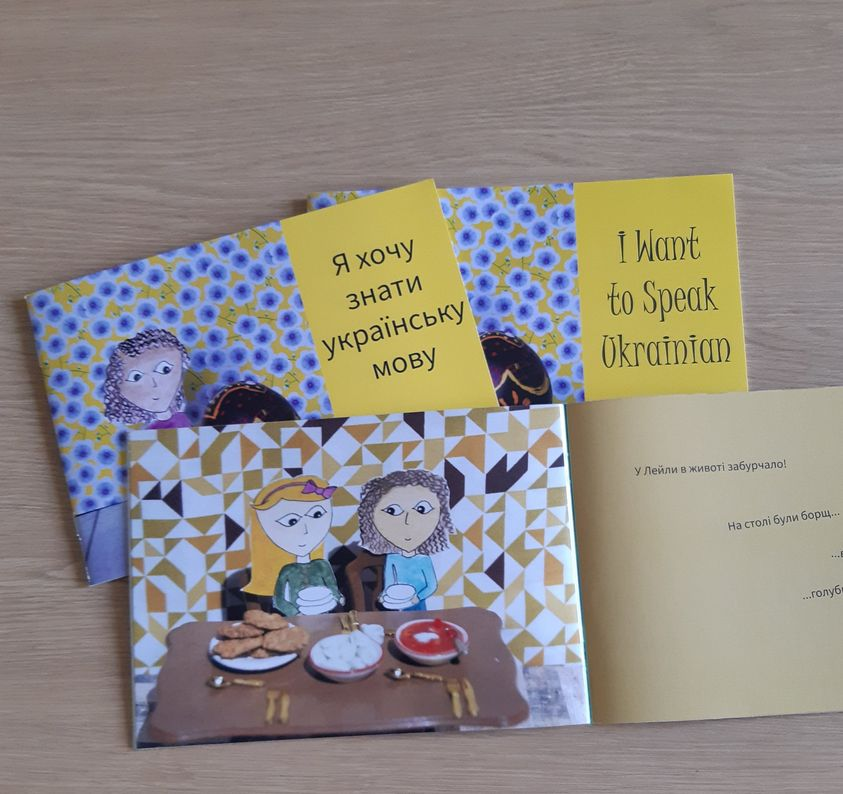
My probably best experience in miniature-making was a commission to make a set of Ukrainian food for a lovely bilingual picturebook. It was quite a challenge. 


Another related achievement was an article published in a dollhouse magazine. It wasn’t the first time, but I felt more proud of it than of my academic publications.


Going back to travel, I fulfilled my grand dream of returning to Camino de Santiago de Compostela, completing the final stretch of 120 km and receiving a pilgrim certificate. Read a full account here. I got to know my fellow pilgrims well, and we are already planning another pilgrimage in the coming year.


I also made a short trip to Gdansk which is a truly amazing city.


I continued leading nature walks during spring, but had to temporarily quit in the autumn because of a foot injury. 


I also continued with my urban walks, based on children’s books, and guess what? I was awarded a very prestigious prize for them! I had thought I was beyond all awards, and it was particularly gratifying to receive acknowledgement for something I was doing right now. The activity is growing, and more and more funding bodies are deciding it’s worth supporting so I am suddenly more involved than I had imagined, for better and for worse. It’s something I strongly believe in.


I also received my second diploma in ikebana, now working on the third and participating in some events apart from my formal lessons.


As I was unable to walk any long distance in summer, I compensated by going wild swimming every morning. 


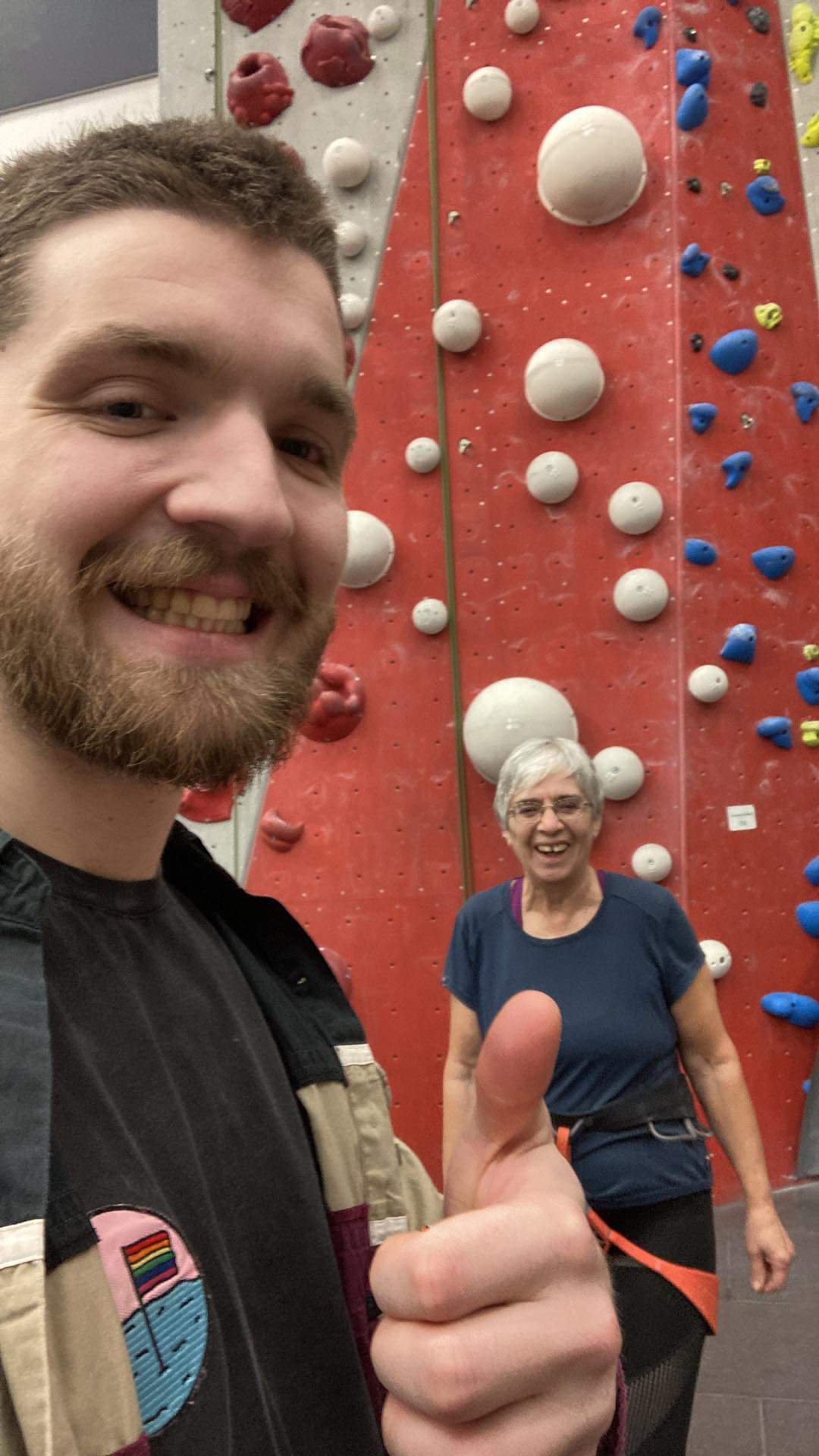
I also did some climbing, not as much as I would have liked to, but my instructor, who happens to be my grandson, is impressed.


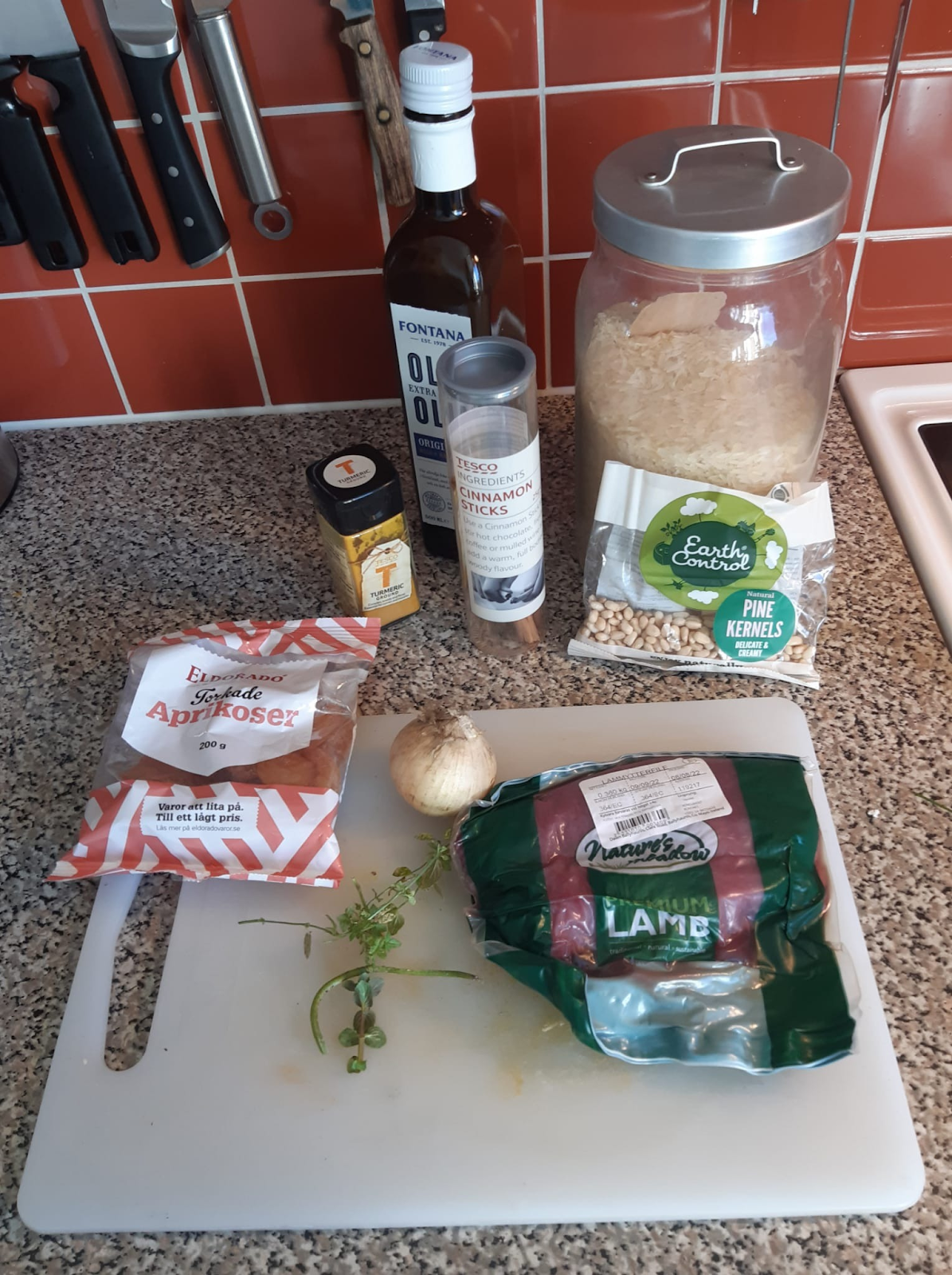
I continued cook-alongs with my Cambridge friend, and in summer we went on a virtual trip with Orient Express, stopping in Paris, Venice, Sofia and Istanbul. We read books, watched movies, listened to music and of course cooked food. Believe me, it’s a great way to stay in touch when you cannot visit in real life. We planned to go to Paris for real, but again I got very ill so sadly it didn’t happen. Maybe next year.


There wasn’t much to do in terms of home improvement, but my wonderful grandsons helped me remove the horrible carpet on the balcony and replace it with a lovely wooden deck. The balcony was once again a source of much joy.


I made substantial progress with Welsh, and I am now halfway through the course. In summer, however, I took a break and learned some Spanish in preparation for my trip to Spain. I actually could say quite a few phrases when I was there.

Like last year, I set a goal of reading thirty books, but I didn’t have any theme so it was a mix of contemporary Swedish and contemporary British, of the latter Ian McEwan’s new novel, Lessons, was probably the strongest impression, alongside French Murial Barbery’s The Elegance of the Hedgehog.

I have been an ardent moviegoer, thanks to my grandson who works in a cinema, but I have also watched numerous films and tv series at home, thanks to all great streaming platforms. The same grandson made sure I didn’t miss any important theatre, opera and ballet performances. Two highlights: Strindberg’s Miss Julie and Brecht’s Life of Galileo. Not to mention all concerts, both my subscription concerts and several on top of those. Occasionally I attended 2-3 events in a week. Quite recently I made a big musical discovery: Ethel Smyth. A good example of the benefits of subscription: I would probably never chosen this concert on my own.

I could go on, but I think I have made my point. It has been a very dark year, and no light any time near. And yet life goes on, and it’s a wonderful life that I wish everyone could enjoy in their retirement, although I am well aware of how privileged I am. Not least thanks to these lovely friends: 


Let's not lose hope! Happy 2023!

Tuesday, 13 August 2019

Fond memories

I am looking forward to IRSCL congress that starts tomorrow. It is a coincidence - or maybe it is not - that what is likely to be my last conference is hosted in my home city by the organisation which has played such a central role in my professional life.

Four years ago, I wrote two nostalgic blog posts after IRSCL conference in Worcester. I won't repeat it: read here and here.

But I have found some pictures from previous conferences.


This is Moscow 1981. I wasn't a member, I was interpreter and guide for the Swedish delegates. At that time, I couldn't even dream of becoming a member, still less the president.


Yet, here I am, two years later, in Bordeaux, giving a paper.


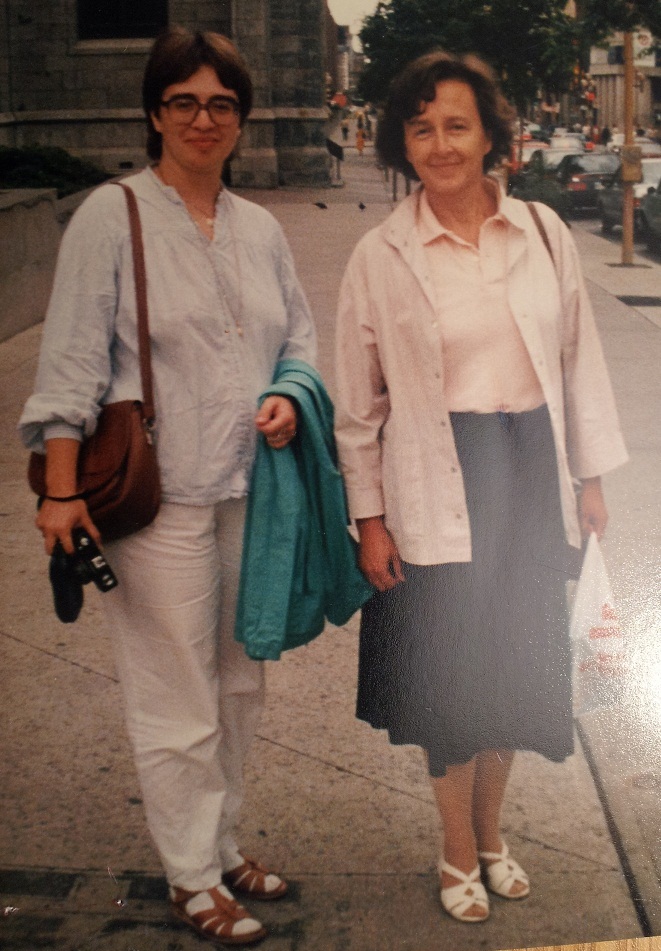
And here I am, in 1985, in Montreal, with Petra Wrede from Finland.

Somewhere in storage I have more pictures, from conferences, Board meetings and crayfish parties. This last one gives you a very good idea of how much fun you can have at a Board meeting: in San Diego, with Carole Scott, John Stephens and Thomas van der Walt.


Saturday, 15 August 2015

Conference nostalgia, part 2

Read the beginning of this story here.

I almost didn't go to the 1993 IRSCL conference in Geelong, Australia, because I had just returned home after six months in the USA, but I was younger then, and Australia was enticing, and I was a board member with another term of service possible, and everybody knows that you don't get elected if you aren't there.

But, absolutely honestly, when I went, I was not expecting to be nominated for presidency. I hoped to be re-elected to the board, and I hoped that the new president would be nice to work with. These days, elections are prepared well in advance, and the candidates circulate their CVs and personal statements. Which is the way it should be. But in the old days, board members were recruited on the spot, as late as an hour before voting. As we were finalising the programme, the current president asked whether I would like to stand for election. I was overwhelmed. When I sais, yes, I would, she told me to cherry-pick my board and tell the election committee. I looked around. I cherry-picked my board. It was a great board, and we spent many good days together in various parts of the world.

I was immediately faced with a huge problem. Typically, biennial conferences would be planned far in advance, so that at any conference the next one would be already in progress and the one after that under negotiation. I had no conference bid, and the only solution was to do it myself. Which I did, and it was the worst nightmare of my life. I can say it now, twenty years later, because I know that people who were there remember it as a very successful conference. Only I know about all the small disasters, and in retrospect I shouldn't have done it, not there and then, but did I have a choice, a newly elected president with no conference bid?

Twenty years is a long time ago. I remember the board meetings leading to the conference: deciding on a theme, discussing keynote speakers, sending out call for papers. It was in the stone age before everybody had email - we sent 300 printed copies of the newsletter to forty countries. My department covered the costs.

Selecting papers, compiling the programme, finding session chairs. This was also the first year we gave the IRSCL book award. A lot of work for the board. But the bulk of the conference preparation was in Sweden, and I would have never managed it without the strong children's literature community, not just my university, but the Children's Book Institute, the Writers' Union, the illustrators, the libraries. I could arrange a reception at the City Hall, the venue of the Nobel banquet. There was an evening archipelago cruise with shrimp dinner and dance. There was a post-conference trip to the Astrid Lindgren theme park.

I made tons of mistakes, but I am not telling anyone, and it wouldn't be helpful because no conference is like another one.

I was re-elected for another term, but it was simpler because we had the next venue and theme, and the board meetings were less stressful for me. The 1997 conference was in York, UK, and I stepped down, but stayed on the board as immediate past president to ensure continuity. Almost the whole board stepped down, which is never good, but there was a new bunch of people coming in, and things were changing. In 1999, IRSCL had the first and only joint conference with the rival organisation, the Children's Literature Association. Some people wanted the two organisations to merge, while there was strong opposiiton to this. A one-off joint conference was a compromise. IRSCL had initially been a Euro-centric organisation, even though two presidents has been from the USA. The York conference yielded many British members, and after the 1999 conference in Calgary, which was great fun, a deluge of US members came. I was surprised to learn, at the membership meeting in Worcester last week, that a third of the members today are from the USA. There weren't as many in my days.

But my days are long gone. When I skipped 2001 in South Africa because we had just moved back to Sweden from California, I thought it would be just one time. In 2003, when it was in Norway, just around the corner, I had prepared a panel with my colleagues and students from the Nordic Children's Literature Network (NorChiLNet), but had to cancel at short notice because of severe health problems. I missed Japan in 2005 and Ireland in 2007 for the same reason. I went to Frankfurt in 2009 because it was a reunion: 40 years since the organisation was founded, and all past presidents who were still alive were there.

I missed Brisbane in 2011 and Maastricht in 2013 for various reasons. It was sad, because I once invested so much in this organisation and it meant so much to me. Therefore it felt such an honour and pleasure to be asked to do a keynote in Worcester. How many years after presidency do you need to be in quarantine?

I believe I was the longest-standing member at that conference. The membership meeting asked me for clarification of some history. On the last day, a French colleague arrived. It was the person who asked me a question at my very first conference in Bordeaux in 1983.


Saturday, 5 October 2013

Nothing happened...

“You haven't blogged for four weeks”, Staffan points out. He is right. I haven't. When I don't blog for a long time, it can be for two reasons. 1) nothing has happened. This doesn't happen often. 2) far too much has happened. This happens all the time. When it happens I don't know where to start and let still more time pass and more things happen.

With reference to my account of imminent events, the viva went well, but I was so worn out when I came back that I cancelled all travel until Christmas, except Stockholm where I had too many important commitments. The Stockholm trip went fine. Staffan took me to Stansted. I was picked up at Skavsta by my oldest son who “happened” to be in the vicinity (which he has now admitted implies that someone dear to his heart lives close by). He took me to the place where I was staying, which is the International Writers' Guesthouse, in the very centre of the city. It is a small, but comfortable flat with three rooms and shared bathroom and living room-cum kitchen. During the week I stayed there, I saw a glimpse of my neighbours twice.

In the morning, I went down to a cafe for breakfast. It felt weird. The guesthouse didn't have wi-fi, only a USB cable, while I had brought my paddy. But every cafe with self-respect has wi-fi these days. Some of them have “coffee” for password. Then I bought some stuff for future breakfasts and topped up my travelcard. I had a long, pleasurable lunch with a friend, ending in incredible luck in a thrift shop where I found some remarkable dollhouse miniatures and spent more money I would be prepared to spend “at home”. But I wasn't at home, I was travelling, and then you are allowed to spend more. In the evening I went to admire how the youngest and his girlfriend had re-recorated their flat and to taste her famous and fabulous onion soup. The next day was also full of children and grandchildren, and that night I got horrendous neck pain. I often get stiff neck and know how to deal with it, but this was unbearable, and eventually I gave up and went to Emergency. It transpired that I wasn't a resident. “It will be expensive”, said the receptionist. “How expensive?” I asked. She named the fee. “Do I have a choice?” I said. So much for having paid taxes in my own country for twenty-five years. I got painkillers, and my clever daughter made me buy a wheat pillow, which is a bag of wheat that you heat up in a micro and put on your neck. I have now become addicted to it. I sat with it on my neck throughout the conference.

It was a very strange feeling because normally you go away to a conference, and although technically I was away, I also was kind of at home, but not really, since I didn't stay at home, but in a hotel. In the middle of the conference I escaped to attend a family crayfish party which was marvelous and far too noisy. It was also weird to travel back to Cambridge with the students (back home) and with my friend Kin (going away together) who was to stay with me for a couple of days. On top of it, Staffan was going to Stockholm the day after, but I won't go into more detail.

Kin and I had fun together when I wasn't busy with examination boards and crisis team meetings. We did all the necessary sights in Cambridge and around, went to Formal Hall (where I was obliged to say grace, as I happened to be the most senior at table) and even watched a movie. Then the pre-term business hit me: meetings, business lunches, early supervisions, arriving visiting scholars, a row of formal dinners with details I wish I could write about, but I shouldn't. And the next week it finally starts for real: PhD induction on Tuesday, masters induction on Wednesday, academic assessment meetings and meetings about the new Head of Faculty, more supervisions (I have four new PhD students), more formal dinners, various committee meetings, College Council, research seminars – all this in addition to teaching which I, according to my job description, am supposed to do “every now and then”.

Tuesday, 22 May 2012

Report from the celebration marathon, Day 5


Somehow, I've run out of steam, and last week feels like plusquamperfectum, but I guess I owe you, My Dear Reader, the conclusion of the story.

The journey home was uneventful, the always-on-time airline was on time, and we were safely in bed long before midnight. The cat didn't seem to have noticed our absence. I was still feeling horrible the morning after, and if it hadn't been a dinner for me that night, I would have sent an apology. But you can't flake from your own birthday dinner. I considered asking Staffan to drive me and taking a taxi home, but decided against it. However, I realised my mistake when I parked in the large parking structure and walked through the weirdly empty mall with all shops closed. A bad movie played in my head: I never turn up at the dinner, and my cold corpse is found next morning in some dark corner... It was too late to get out and park elsewhere. I decided not to let the prospect of going back into the parking spoil my evening.

I was the first to arrive, which I always find awkward – yet another example of my “victim behaviour”. But the table was ready, and very soon another colleague arrived, and I had to relate the events of the week once, and twice and all over again as the table filled. I had never been to this place before, although I drive past it every day. It is very discretely hidden behind a kitchy Eastern European delicatessen that has advertised its imminent inauguration for the past year. But next time I want to invite someone to a fancy dinner in Cambridge, this will be my choice. Even with all the previous nice meals of the week, that one was by far the most exquisite (sorry, Clas på hörnet).

What's more, I had thought that I had heard so many nice words during the week that I wouldn't be overwhelmed again, but I was. And these were not big words in front of a gathering of people, but words spoken by a very intimate group of colleagues whole opinion I value. I won't say they were surprising, but rather unexpected, because they weren't the kind of words people are obliged to say, but the kind they say because they want to. If you know what I mean. I was moved more than I perhaps showed since, honestly, I didn't know what to say except repeated thank-yous which isn't a very nuanced response. I will have to find a way of saying thank you properly because these people have made the past four years of my life possibly the most happy years and definitely the most satisfactory years professionally.

When we were leaving, I asked the only male in the group to accompany me to the parking structure. 


Sunday, 20 May 2012

Report from the celebration marathon, Day 4

See Introduction, Day 1, Day 2, and Day 3

Since I was a good girl and went to bed early I woke up as usual, and Staffan and I and cousin Birgitta had breakfast together. Then Staffan took Birgitta to the railway station and went to do more shopping (that is, making purchases), while I had another cup of coffee with Sergej with the two little girls efficiently preventing us from talking. They were very excited because they were going to a circus that day. I tried to pay for the coffee and soft drinks, but the waiter said it was on the house. Given the bill we had paid, a cup of coffee here or there didn't make much difference, but it was nice of him.

Then we went over to Julia's. They had moved last autumn, and we had not been in their new apartment. It was light and decorated with great taste – not that I had expected anything else. I could tell that there had been some negotiations, but I could also feel that they both love the space they have created together. Some of their common and individual hobbies were tangibly present. I made myself stop being envious. Not envious as I am now, but envious for me thirty years ago. I am in fact happy that my daughter has a room of her own.

Then the guests started coming, and there were hugs and presents and flowers “for the hostess”. Julia had made some canapés and cupcakes, and there was sparkling which I carefully avoided having in mind flying in just a few hours. Most of the friends hadn't seen each other for years, possibly since our farewell party almost four years ago. They obviously enjoyed talking to each other. I kept looking at the clock and trying to figure out how much of the presents I would be able to pack in our already full suitcases. I had to leave behind a huge painting that my sister-in-law had sent, one from Staffan's childhood home. I like it, and it would go well with other art we have, but it will have to be another time.

I had to hint to some friends that we actually had a plane to catch, which they found weird (one friend had sent apologies because she was travelling the day after), but then they know we are weird. We left three bottles of expensive wine to Julia and Pontus since there was no way we could take it with us.

The drive to the airport was painless, and we arrived an hour before check-in even started so we had a light and quite decent dinner. The departure hall brought the memories of four years ago when Julia had taken me to the airport, and all bridges had been burned. I made the memory go away. This time we were returning home.

To be continued. 

My wonderful in-laws Elise and Christian took pictures. 

Saturday, 19 May 2012

Report from the celebration marathon: day 2 and 3


Click for Introduction and Day 1

Day 2 was uneventful. I woke up as poorly as I went to bed. I had a supervision at ten and a meeting at eleven, neither of which I could cancel because they were among the ones I had to cancel the week before. The meeting took longer than I had anticipated, and finally I had to say: Sorry, gentlemen, I have a plane to catch. Which was almost true, because I just about had time to get home, pack the last things, have a quick lunch, and off we went. I had been living completely in the now and hadn't registered that our flight actually left at five, not at eight. The queuing at Stansted was as tedious as ever, and at security check I realised that I had my throat spray in my backpack and was too lazy to return and get a plastic bag. I was to regret it bitterly during the days to come.

We decided that we could just as well eat something on the plane. It wasn't a gourmet meal, but we were looking forward to a number of those, and at that point we just needed something in our stomachs. Getting our rental car was quick, and it didn't take us more than an hour to get to Stockholm (airport bus usually takes an hour and a half). I had to remind Staffan to drive on the right, and we kept telling each other what a pretty landscape we were driving through. Eventually we came to Clas på hörnet, and I had a cup of tea and went to bed.

I had not expected champagne breakfast in bed and fortunately didn't get it. The breakfast was nice, and after that Staffan went shopping (although he would characterise his action as “making purchases”), and I don't remember what I did. Probably was nervous. From an email that Staffan had sent to me by mistake I knew that the mystical lunch guests had multiplied and were now ten rather than two. It could only mean one thing, and I was right, but it didn't take away the joy. Promptly at noon I went down to the dining room, and there they were, my wonderful former students from Finland and a couple of former colleagues, and did they sing for me? And what did they give me?


Yes, I had anticipated a festschrift, but it was a wonderful surprise nevertheless, just to see who had contributed and who was on Tabula Gratulatoria, and how much thought and love there was behind this volume.

A festschrift is a very special kind of book. It is academic and occasionally contains truly ground-breaking scholarship. But it also allows light stuff. I once contributed to a festschrift for someone I knew collected hippos. I wrote a piece on the semiotics of hippos in children's literature. I had fun writing it. I hope the object of celebration had fun reading it.

There is no festschrift tradition in the UK (I actually had to explain to my Cambridge colleagues what it was), but in Germany and Scandinavia is it common to produce one for people's sixtieth, and it is a great honour, a recognition of your academic career. As I say, I half anticipated it, but actually didn't believe I would get one because I no longer had a Scandinavian academic affiliation. In fact, I remember saying to a Swedish colleague at a conference that I didn't expect a festschrift. And she was part of the conspiracy! But it was two former students, nowadays younger colleagues, who edited it, behind my back, tracking down people with whom I had lost touch, but who remembered me well enough to be willing to give me their precious time and energy for my birthday. There are four poems, and all articles are somehow connected to my academic work; one of them is a very rigorous critique of my PhD, and I haven't yet figured out whether it is a joke.


To be continued.


Here are my mystical guests: from the left (not counting Staffan) Janina Orlov, Elina Druker, (me), Ulf Stark, Mia Franck, Kin Hallberg, Mia Österlund, and sitting, Maria Lassen-Seger.

Report from the celebration marathon day 1


You can plan as much as you want, but fate will always decide otherwise. To begin with, I got a most nasty flu the week before. So nasty that I had to cancel all meetings and supervisions and spent most of the week in bed. The cancellations included the born-on-May-16 drink, and I already had a vision of the Homerton reception going on without me (so that they could say what they really think of me), and non-refundable air ticket, and all the mysteries and surprises wasted. I did go to work on Friday, but felt profoundly rotten. At lunch, Morag asked me whether I liked surprises. By that time, I didn't care. Just as I was about to leave, one of the born-on-May-16 ladies came into my office with a lovely tea-tree, hurrying to say: “I know you said no presents, it's not for you, it's for your garden”. It was very sweet of her, but the idea of having to plant a tree almost made me sick. I went home and spent two more days in bed, contemplating the Universal Injustice.

On Monday morning I dragged myself out of bed and went to a long, albeit productive meeting. Then I went back home and drank gallons of tea with honey. It was cold and rainy, and putting on the new outfit purchased for the occasion was out of the question. I was unreasonably anxious. When I was in therapy many years ago, my counsellor explained to me that my attitude to life was called “victim behaviour” meaning that whatever happened I thought it was my fault. She helped me deal with it, but sometimes it breaks through. I kept thinking it was the wrong day, and I had ordered too little or too much food, and the invitations had been sent long ago so people would have forgotten and nobody would turn up; and although I was unquestionably a Fellow people would think or even say: Who is she anyway; and I would stumble and fall because of my high heels; and what if I just take my car and drive as far away as a full tank would take me.

I was brought back to earth when I went to the ladies' and saw a sign outside Combination Room


Then of course it was all around me, the food and bottles arrived (just a bit late, and I had to remind them that I had ordered sparkling rather than regular wine), and the students gave me an olive tree, repeating the reason: “It's not for you, it's for you garden”. And when I started on my well-rehearsed speech, I suddenly forgot all I wanted to say and certainly sounded daft, but hopefully, being the object of celebration, was forgiven. 


Then came the surprise. Morag had warned me, and I was pretty sure the students would bring a cake, since they are famous for their cakes, but I wasn't prepared for what was to come. I had thought maybe a gift card for a garden centre or a dollhouse shop. Or a visit to some famous garden or a garden show or a dollhouse fair. Somehow my thinking didn't go beyond gardens and dollhouses, since I knew that all my friends knew about my major passions. But Morag knew me better than I knew myself, and she had taken a completely different direction. So what did they get me? A day with a personal shopper! It took me a couple of moments to take it in: Are they saying that my taste in clothes is so poor that I need guidance? But no, of course not, they know I love nice clothes, but hate shopping, so this was exactly what I didn't know I wanted, and it wasn't a present, but an experience, and it was the very best thing they could think of. They gave me a card which everyone, really everyone had signed, and Morag said afterwards that she hadn't anticipated such wide and generous response. She had started with just a few people, but apparently more people had heard and wanted to contribute, which felt so good I didn't even know what to say. To add to my confusion, the students brought out a cake so pretty I didn't dare to cut it, but I had to blow the candles, which I am sure I hadn't done for the past forty years. 


I think everyone enjoyed it. Two things nearly killed me though. Every five minutes I had to run to Staffan, who was sitting quietly in the corner, and borrow a tissue to blow my nose. I hope people thought I was moved to tears, but in fact my cold was getting worse. And by the end of the second hour my heels felt like torture tools, so when we finally left, I took them off and walked in my stockings, but I don't think anyone noticed or cared, because I was already carrying an olive tree, some wine bottles and boxes of chocolate (“No presents!”), a huge bouquet (“No flowers!”) and a pile of cards.

Needless to say, I went straight to bed.

To be continued.
Photos by Faye Yung. 

Report from the celebration marathon


Dear Reader, it cannot have escaped your attention that yours truly has just passed the magical threshold. The various stages of celebration went on for almost a week, reminiscent of the famous story of a royal relative sending a belated cable to the Czar of Russia: “For three days running we have been toasting your health”, to which His Majesty replied: “High time you stopped”.

About a year ago when I first started planning my sixtieth, there were many options I considered. One was to bring the whole family over to Cambridge and have a big party including local friends. It probably wouldn't be unreasonably expensive, but the logistics was too complicated. Therefore I asked the family to keep the date open and await further instructions. Ten years ago, for my fiftieth, I had a huge fancy dinner for friends, colleagues and grown-up family members. I couldn't possibly repeat the grandeur of that one, and I also felt that I wanted all the grandchildren to be present. Eventually we decided on a family-only dinner. We considered a stately home outside Stockholm, but again the logistics would be hard, so we found a very special place in town where we had been and knew the food was superb. It turned out they also had rooms.

That done, I started looking around for some form of celebration here in Cambridge. My first thought was that I only had been here for a short time, I didn't have many friends... and then I started counting, and when I got over forty it was pretty clear – apart from the happy realisation that I did have plenty of good friends – that some event was unavoidable. Moreover, it definitely felt a pleasure rather than a duty.

However, I didn't want to have a garden party at home. I've had those, and the house is big enough, but somehow it felt wrong for the occasion. I made some investigations and decided that the Combination Room at Homerton had the necessary ambience and that their catering would be good value. I decided that a Monday afternoon would be suitable, since people might not want to come in on the weekend. My first attempt was discouraging since the catering people demanded room hire double the costs of the reception itself, although I suggested that as a Fellow I might be allowed to use college facilities for free. I emailed a polite “Thank you, I'll look for another option”. Half an hour later they got back saying that the college Bursar had waived room hire.

As I was relating it all to Morag she wondered whether I would accept, as a birthday present from the teaching team, a fancy dinner. That sounded nice. More or less at the same time, Staffan announced that apart from the family dinner on the day, there would be a surprise lunch with two overseas guests who just happened to be in Stockholm. The serendipity wasn't very convincing, but he refused even to hint who the guests might be. I had my guesses, but he wouldn't confirm or deny. I was almost hundred percent sure the mysterious visitors would be from Finland because it was the only reasonable guess, and I thought that perhaps they would offer me an honorary doctorate. Another option might be a festschrift, but I didn't quite believe it.

As I sent out invitations for the reception at Homerton, two people replied with a comment that their birthdays were two days later, on May 16. I had never, ever met anyone with the same birthday as mine so I wrote back pointing this out and suggested that we three born-on-May-16 ladies should go out for a drink together. Which both thought was a brilliant idea, and we even managed to find a date, after a Faculty meeting the week before.

Meanwhile, my thoughtful daughter Julia wondered whether I seriously considered ignoring all friends in Stockholm and volunteered to do a reception for me which was a very noble action. She immediately created a Facebook event, and the two Facebook-passive friends also received invitations by email. Most of them responded at once and were delighted.

Thus the celebration was to continue over a week: drink with born-on-May-16 ladies on Thursday, Homerton reception on Monday, flight to Sweden on Tuesday, surprise lunch and family dinner on Wednesday, reception on Thursday, back to Cambridge on Thursday evening, and a dinner with close friends on Friday. For each occasion, I very strictly specified: no presents, no flowers, although I was sure at least some people would go against my wish or simply fail to read the instructions. As the date approached, I was torn between happy apprehension and horror. Some days I wished I had decided to disappear to an undisclosed destination.

To be continued.

Thursday, 23 February 2012

Musical memories

“I am very fond of Rachmaninov's Second Piano Concerto”, she said. “And from now on, this piece will for me always be connected with you, and for you with me, yes?” And so it is. Every time I hear Rachmaninov's Second Piano Concerto, which apparently is number one favourite at Classic FM that I listen to in my car; every time I hear it, I remember her.

I was eleven, and she was fifty, and we were at the composers' holiday home in Karelia. I ran wild with other kids. We made model boats and sailed them in the huge, dangerous Ladoga Lake. Maria Pavlovna, a fifty-year-old librarian from Leningrad, watched us. She told me about the book by Alexander Grin, Scarlet Sails, which became a great favourite for many years to follow. Her association was merely that we played with boats.

For the next year, we corresponded. Looking back, I wonder why MP bothered to write and receive letters from an eleven-year-old. She wasn't married and had no relatives. I wrote to her because I was a passionate letter-writer. I told her about what happened at school, who my friends were and what we did, what books I read, what concerts I went to and what art exhibitions I saw. I sent her my poetry which I normally didn't share with anyone. She wrote about her work and her friends, and about her childhood. She called me Little Grasshopper after a nursery song.

Next summer we met again, and I was adopted by four ladies who hiked, rowed, played party games and treated me as an equal. One evening we listened to Rachmaninov's Second Piano Concerto on an old record player in the music room. Then another year of correspondence, and another summer. She only came for four weeks of her summer leave, I stayed for the whole summer. I cried when she left. My father scolded me. “When a stranger leaves, you cry. When you mother comes, you don't care”. It speaks volumes about my complicated relationship with my mother. You needn't be a Freud.

Once I went to Leningrad with my father, and we were invited to MP's tiny room in the huge communal apartment. I felt awkward. Once she came to Moscow and was suddenly sitting in my bed sofa. I wanted to hug her, but didn't dare. My father's opera was performed in Leningrad, and I insisted on MP being invited. I was showing off and felt bad about it.

When I was fourteen I had, as I realise now, a very bad depression. There is nothing unusual about a fourteen-year-old having a depression, but looking back I wonder why nobody paid attention. In my letters to MP I was suicidal. She must have been torn between loyalty to me and her duty to alarm my parents. I don't know whether she actually contacted them, but if she did, it had no effect.

Then she told me a story that sounded like a Hollywood movie. When she was young, she had a suitor, but nothing came out of it. Not that she wasn't interested, but sometimes things just don't happen. He had moved to Siberia, she had lost track of him, but then somehow she found out where he was and sent him a card for his 60th birthday. Like herself, he was all alone in the world. They started a correspondence. I was allowed to follow the development of this incredible plot, and finally MP told me that they were going on a holiday together, meeting for the first time in twenty years. I was fascinated. I was perplexed that these old people, ancient people had feelings. I was fifteen, bursting with feelings and confiding in MP just as she confided in me. Why did she confide in a fifteen-year-old? No one else to share her belated happiness with? So sad.

For winter holiday I was allowed to go to Leningrad on my own. Accommodation was arranged with family friends, and I called MP to tell her I was coming. An indifferent voice informed me that she had died. I only had had a letter from her a couple of weeks before. At that time I didn't find it strange that an old, ancient person died, but she was merely fifty-four, far too young to die. I didn't bother to find out whether she had been hit by a car or had had a stroke. It didn't matter. And I knew no one who had known her, she had been all alone in the world apart from me and her friend somewhere in Siberia of whom I only knew his first name. I would have liked to write to him, but there was no way.

I had a bundle of letters left, which I eventually burned together with many other relics of my childhood. I have a photo. And I have Rachmaninov's Second Piano Concerto.


Sunday, 19 February 2012

A voice from our mutual past, Part 2

Here is the rest of the story I started yesterday.

Marina found her love at a New Year party in my home. It was a portentous party where many a union was made, and also for me it became indirectly decisive. Marina was married, the first of my close friends, and they went to live in a tiny room in a communal apartment with twenty other people, one bathroom and one kitchen. A neighbour would bring her dog to the kitchen to pee in other people's pans. If you think communal living is cute and that people in the Soviet Union chose overcrowded living, you are wrong. But Marina and her husband were lucky to have at least a room of their own which a relative rented out to them. The alternative was to share a room with either set of parents.

Once Marina gave a birthday party in this room, and I helped her to make a cabbage pie. One of the neighbours – not the one with the dog – praised my sliced cabbage and instructed Marina to learn from me. Ah, we were young and carefree then!

I also got married and got a baby, and Marina got a baby a year later. My husband and I were also at the relatives' mercy with housing. We four decided to buy an apartment together. It was possible to buy a three-bedroom apartment in distant suburbs, and putting our meagre resources together we could just about afford it. We would have a bedroom each, a nursery and a common living room. We would babysit for each other and cook every other day. But the authorities wouldn't let us. They said they were trying hard to provide every family with an apartment, while we wanted to create a new communal dwelling. We tries to explain that we would do it voluntarily and wouldn't bring dogs to pee in each other's pans, but to no avail. Finally, Marina and her husband managed to borrow enough to buy a two-bedroom flat in a new development so far away that you had to change buses twice to get there. There were no shops nor any other services, so they had to buy food in town and carry home on those buses. They were promised a phone line in five years, with luck. When we went to visit, you could never be sure whether they'd be at home. I know it sounds weird, but it was about thirty years before cell phones.

I was by then divorced and a single mother, but because Marina lived so far away we couldn't, as we would have liked to, babysit for each other. But we would meet every now and then and let our children play together. By the time I left for Sweden, she had had another baby, which was almost a heroic deed then. Two children was well beyond what anyone could afford. Stories Marina told me about how she managed are too horrible to repeat, but I recognised them. There was a short period in my life when I had nothing but dark bread and cabbage in my home, and when I could afford milk I gave it to my baby. Mind, my parents were well-off by Soviet standards. Marina's weren't. They would have helped her if they could.

I would meet Marina when I came to visit from Sweden, but one day she wasn't there anymore. She had divorced her husband, married a Canadian and moved to Canada taking her two sons with her. Our mutual friends made no secrets of it being a marriage of convenience. Vague information came about her unimaginable hardships. She never contacted with me, and I knew why, because I had encountered this type of behaviour before with emigrees. Unless you are a success story, you don't want to share it with your friends. Eventually I learned that Marina's younger son had returned to Russia and his father. Then I lost touch altogether. I've been to Canada quite a few times, and each time I told myself I should try to find Marina. It wouldn't have been difficult once internet was available. But something stopped me. If she didn't get in touch maybe she didn't want to.

And then, a couple of days ago, an email. And yesterday, a long Skype chat, and all memories, and it feels as if it was just a little while ago I carried soap dishes she always used to forget by those horrible wash basins by the cold barracks, and it was only yesterday we took our boys to each other's birthday parties, and it was only yesterday we dreamed of the future, and here we are, right in the middle is it. She teaches at the University of British Columbia and has four grandchildren.