Showing posts with label Swedish. Show all posts

Tuesday, 17 September 2019

Literary Stockholm, part 6: City of My Dreams

Read the background for this blog series.
Read Part 1, Part 2, Part 3, Part 4 and Part 5.


According to my Goodreads account, I had read this novel before, but I had no memory of it at all, and as I was re-reading, nothing rang a bell, so it must be one of those books that you think you have read because you should have. I believe I had it in my book shelf once upon a time, and I am pretty sure it was on the syllabus when I studied Swedish literature. 

Per Anders Fogelström is a very prominent Swedish 20th-century writer, and his most famous series of novels depicts several generations of working-class people living in Stockholm from 1860s to 1968. By serendipity – or maybe not a all – one of my recent walks took me exactly to the place where City of My Dreams is set, Åsöberget on Södermalm. At that time, it was slums where harbour workers and prostitutes lived. A small part of it has been preserved as a cultural monument and looks rather idyllic today. 
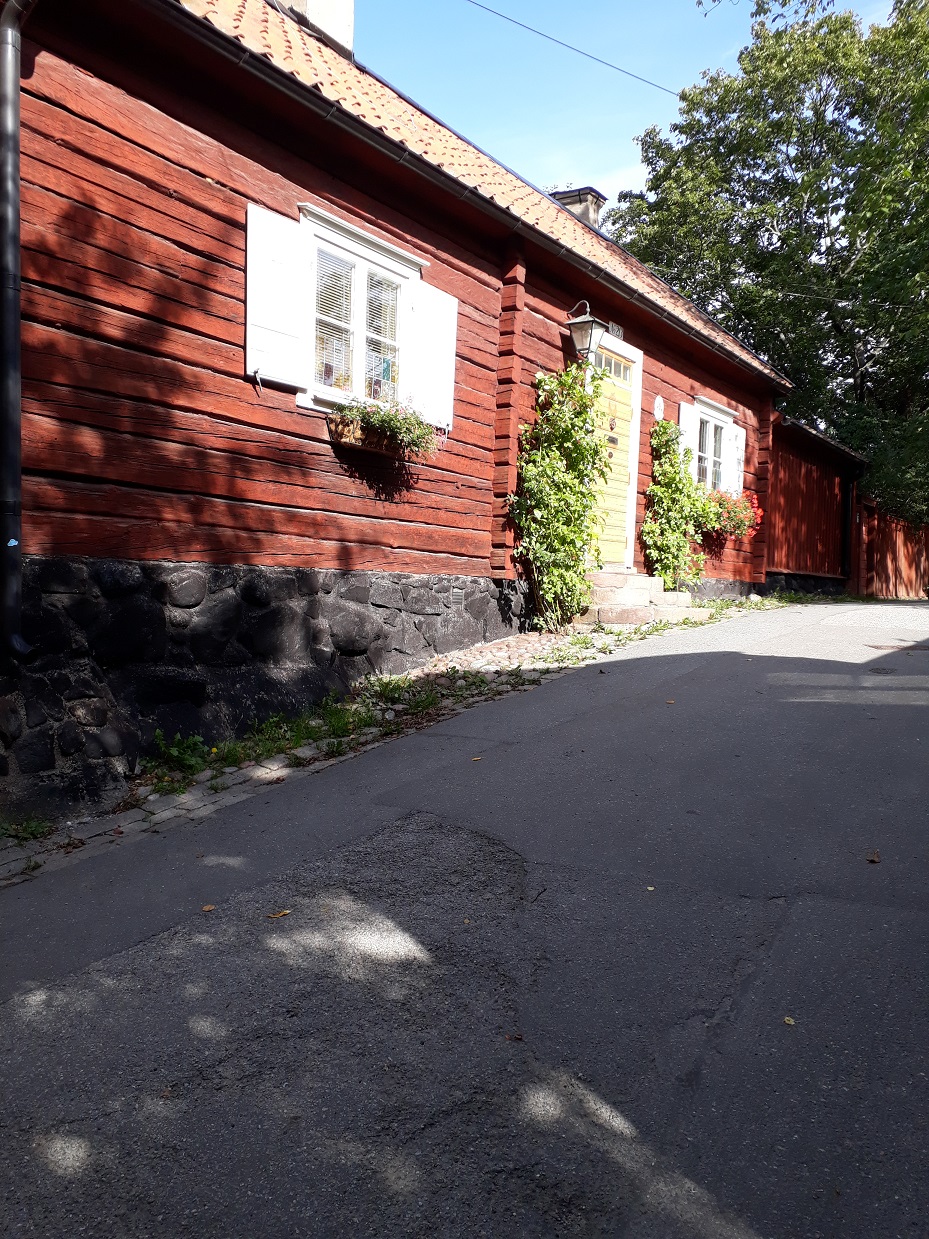


It was illuminating to have seen the place just before I read the novel. The characters also take strolls in the city, just like I do, and visit places that I have recently visited. So the setting was very vivid, even though I had to rewind the clock one hundred and sixty years back. 

Apart from the fascination of the place, the book was excruciatingly boring. The plot was minimal, and the characters totally flat, without any appeal. It is obvious that the point was to paint a picture of the misery of the working class, the hopeless struggle. So I guess as a document of its time – written with a century gap – it is of interest, but I couldn't make myself care about the characters. The style was this conventional ”And then he did this… and then she thought that… and many months had passed...” It just doesn't work. I conscientiously read the first 150 pages carefully, but skim-read the second half because life is too short to read boring books. 

When I was looking up this book in the library catalogue, most editions were abridged. Perhaps whoever decides still thinks this is a classic every Swede should have read, but realises that no reader today can endure this kind of fiction. I wish I could say there were at least some passages I enjoyed, but I didn't.

Anyway, Per Anders Fogelström's sign is, appropriately, on Per Anders Fogelström Terrace, with the best view of Stockholm. 


Wednesday, 11 September 2019

Literary Stockholm, part 5: Mio My Son

Read the background for this blog series.
Read Part 1, Part 2, Part 3 and Part 4.


If I were to decide, I would choose Karlsson-on-the-Roof as featuring Stockholm in the works of Astrid Lindgren. It takes place wholly in Vasastan where Astrid Lindgren also lived for many years. But whoever decided, chose Mio My Son, that is my favourite, so I won't complain, but it can be questioned whether Stockholm setting is integral to it when most of the story takes place in Faraway Land. Unless of course we adhere to the interpretation that Bosse (for whatever reason, Andy in English) never travels to Faraway Land, but sits on a bench in Tegnérlunden in central Stockholm, imagining the wonderful and dangerous adventures in a parallel world. This is the most plausible interpretation, but a sophisticated one, and without doing any research I would guess that most young readers and many adult readers, if asked where the story takes place, would say, Faraway Land. Because we so much want the unhappy orphan Bosse to find a father and friends. Yet does the character-narrator really believe it himself? He has to shout – represented by italics – that he is in Faraway Land and not sitting on a bench in Tegnérlunden.

I have written extensively about Mio My Son and taught it both in Sweden and in the US. Narrative situation and narrative perspective are the aspects that fascinate me, and the novel, published in 1954, is a very early example of first-person narration in fantasy. Writing in 1992, John Stephens claimed that first-person perspective was impossible in fantasy, but of course since then we have seen tons of examples of the opposite. Yet believe me, as someone who wrote her PhD on twentieth-century fantasy, it was unusual until 1990s, so Mio was indeed a daring text.

I re-read Mio as recently as two years ago for a conference in Cambridge about horses in children's literature. Horses are prominent in Astrid Lindgren's work, and I tried to explore Mio's horse not as his dæmon or Patronus, which can of course be done, but as an artistic device to represent the protagonist's emotional states in a more detached way. Writing this paper, I was looking exclusively at horsey moments so I probably didn't read the whole novel as carefully as I did now. I pretty much know it by heart, although there were a couple of details I hadn't remembered; but I did have strong memory of the narrator going back to his life in Stockholm, so maybe the choice of this book to represent Stockholm is not inadequate after all.

I was struck once again by the beauty of language, the rhythmic flow of prose with a folktale flavour to it.

My own Swedish copy is in storage so I borrowed the book from a library. I don't like these luxury editions of Astrid Lindgren with red cloth quarter bindings because I find them distracting. Otherwise it is exactly the same, with wonderful original illustrations by Ilon Wikland.


I enjoyed re-reading Mio even though I remembered it so well. This book is like a poem that you can read again and again.

The sign is of course in Tegnérlunden, and I sat on the bench I think was the right one. But I had no golden apple and found no genie in a beer bottle.


Tuesday, 10 September 2019

Literary Stockholm, part 4: Johnny, My Friend

Read the background for this blog series.
Read Part 1, Part 2 and Part 3.


I first heard about this novel from a student who wanted to write his BA dissertation on it. A recently published book by a totally unknown author. I read it and was blown away. As were all critics and other children's literature people in Sweden.

Pohl, who otherwise was a university lecturer in numeric analysis, wrote the novel in a creative writing course, and rumours have it that it actually was the course instructor who wrote it. I don't really care, and it does happen that a first novel stays the best. Pohl never wrote anything better, and while some of his later books are good enough, most are typical “problem novels”. According to Pohl, Johnny, My Friend is a problem novel, so as usual authors have no idea about what they do.

I taught it in every children's and YA course in Sweden (even the one titled “The Origins of Harry Potter”) as well as in the courses I taught in California. Sadly, courses in Cambridge offered no opportunities to include translated texts. The novel was published in English by Aidan Chambers during his short-lived effort to bring some European YA fiction to Britain. The novel didn't sell, and most of the printrun ended up in Chambers' basement, from which I ordered copies for my American students, and after some US colleagues discovered this brilliant book, they ordered their copies as well. My Californian students didn't like it because they found too many “strange” details in it. I must add that for me the 1950s Stockholm setting, full of period-typical references, was also strange, but I am more tolerant toward strangeness than Californian undergrads.

Roberta Trites wrote a chapter on Johnny, My Friend for my edited collection Beyond Babar.

I only met Peter Pohl once – he wasn't keen on public appearances. On that rare occasion, he showed an amateur short movie he had made with his students. I have never been much interested in meeting authors, and I haven't got any signed copies of Johnny. My own paperback, full of margin notes and underlines, is in storage – one of the very few books I have kept. So I borrowed from a library. I was surprised that so few branches had copies, although I shouldn't have been. A couple of years ago, when I was revising my textbook on children's literature, I asked my Swedish colleagues whether Johnny was still taught in university courses, because it was very prominent in the previous editions. They said it wasn't. But they agreed that it was one of the best Swedish YA novels ever.

I hadn't re-read the book since I moved to Cambridge, although I had it in my shelf both in Swedish and in English. On re-reading now, I could state that I remembered the plot and most details well, even though you always notice something new on re-reading. I had forgotten that the narrator spends quite a long time discussing the penalistic system – one of the “problems” - in the famous elite high school in Stockholm in the 1950s.

What struck me now is the careful topography. The whole novel takes place within a few blocks on Södermalm – precisely the blocks where I live now. My street is mentioned several times; the temporal “now” of the novel takes place on the corner I pass daily. Of course I knew it then and pointed it out to my students, but I had never walked these streets before. My daughter went to the same secondary school as the protagonist (the school structure was different in the '50s, but the school was the same, “with traditions”, for better and for worse). But I used to drop her off and drive back home so I never took time to explore the setting.

I have now. I have walked every street, including the far away (15-minute walk) square where mysterious Johnny lives. There is no bike repair shop now, but there is a car repair shop, so it may be the same. The magnificent tree is never mentioned, probably because trees are of no interest for eleven-year-old boys. 


The novel is still piercing. It doesn't matter that I already know the answer to the mystery, but I could kill the person who reveals it on the title page. It's like revealing on the title page of a crime novel who the murderer is. I will point it out when I return the book to the library. 


The library edition is from 2006, and there is an appendix, compiled by the author, of the '50s Södermalm slang. Apparently, teachers had asked him to do it, to make the novel more palatable for young readers. Perhaps the generation of teachers who could explain it to schoolchildren has died out. But it was already out of date when the book was published in 1985, and it was a deliberate artistic device.

Johnny is a good example of great books that get drowned in the flotsam of today's publishing. Fifty years from now it may be re-discovered and acknowledged again as the best Swedish YA novel ever. Yes, I mean it. Write to Aidan Chambers – he may have some copies left in his basement.

Peter Pohl's sign is appropriately on top of the steps at Kvarnsgatan where Johnny wins a crate of soda by biking down the steps - see cover image above. The bottom of the steps end in the street where I live. It is one of the first signs I noticed on my walks.


Sunday, 8 September 2019

Literary Stockholm, part 3: Ture Sventon, Private Detective

Read the background for this blog series.
Read Part 1 and Part 2.


“Drottninggatan in Stockholm is a long and narrow street more or less in the city centre. Traffic goes in an endless stream”.

It made me smile to read this opening today when Drottninggatan is a pedestrian street and has been for ages, but who could imagine it in 1948 when the first Ture Sventon book by Åke Holmberg appeared (published in English by Methuen in 1965 as Tam Sventon, Private Detective).

I have never been a fan of this series, even though I once won the second prize for the best costume at one of the Children's Books Institute unforgettable dress-up parties; I dressed up as Mr Omar, wearing a fez, with the famous flying carpet under my arm. Still, I don't find these books funny or thrilling, but I can see why a child in '40s or early '50s might. Or maybe it is the special kind of Swedish humour that aliens don't get. Perhaps they are those books that nostalgic grandparents give their grandchildren for Christmas, and publishers believe they are still popular and reprint. Maybe these books were revolutionary when they came, part of the great post-war children's book renaissance in Sweden. But today there are so many other children's detective stories, written for today's children, that I cannot see why a childish grown-up detective solving idiotic crimes with the help of a flying carpet would have any appeal.

I had a good memory of the silly plot, but I had forgotten that Ture Sventon (he has a lisp - that's why he is called Tam in English) had four sidekicks, four totally flat and boring children whose role is simply to make the book look child-friendly. For it is obviously a parody that goes above young readers' heads.

My library copy is a reprint from 2008, and although the cover designer is not acknowledged, the cover image has been doctored to bring it at least slightly closer to contemporary readers. Compare with the original.


The main character is the same, but the children have been given “modern” clothes – 1960s maybe? Still stone age for today's readers. Title font has been changed, while in the original it repeats exactly the door sign on Ture Sventon's office on Drottninggatan. Yet we do judge books by covers, and although everything in the text must feel ancient, marketing people probably insisted that the cover should be modernised.

Anyway, re-reading Ture Sventon did not prove to be a great aesthetic experience. Fortunately, it is a short book, as children's books were at the time.

Åke Holmberg's plaque is appropriately on Drottninggatan or actually not quite; the guide says corner of Drottninggatan and Jakobsgatan, and it took me some time to examine the two sides of each corner. The sign is inconspicuous and at the moment obscured by scaffolding. I had almost given up before I finally saw it.


Friday, 6 September 2019

Literary Stockholm, part 2: Children's Island

Read the background for this blog series.
Read Part 1.


I am trying to remember when and why I read P C Jersild's probably most famous novel, Barnens ö (Children's Island in English). It was published in 1976 when I still lived in Russia and had no easy access to foreign books. The most plausible is that I read it, and possibly got it as a gift from the publisher, at the first Moscow Book Fair in 1977, or maybe I just saw it then, or maybe I was asked to read it for a Russian publisher who was considering a translation. Jersild was at the time being considered for translation, because he was viewed as ”progressive” and socially engaged, but Children's Island would be out of the question for many reasons.

I thought I had a good memory of it, but apparently this memory was entirely based on the film version, directed by Kay Pollak and screened at the Moscow Film Festival in 1981. (At that time, I already knew Pollak well, because he had attended the Festival in 1977 when I was his interpreter).

My memory was rather idyllic, and what I remembered best – probably again from the film image – was the bald young woman Nora who saves Reine from drowning. I had no memory of their meeting after that. I remembered that Reine ran away rather than being sent to a summer camp, the titular Children's island, and roamed Stockholm, finding all possible and impossible ways of fending for himself. I had forgotten that he found a job painting funeral ribbons. I remembered that he was reluctant to come into puberty and contemplated life and death. But I had forgotten the incredible violence and self-destruction. I remembered his hunger, but I had forgotten the detailed descriptions of his defecation. Did I really read it back then? Can you forget such details?

It is not a children's book. I used it in my teaching as an example of a novel that is not a children’s book even though the protagonist is eleven. Did I re-read it then or trusted my unreliable memory?

I wonder whether this novel would today be marketed as a young adult or maybe crossover book. Things have changed in the past forty-five years. It has never been marketed as a YA novel in Sweden. I wouldn't give it to an eleven-year-old.

What I could not help thinking about as I was re-reading it, or maybe reading it for the first time, is how specific Jersild is with Stockholm topography, plotting Reine's bizarre trajectories. Reading it now, I recognise every setting – I have actually just been to most of the places mentioned: Concert Hall, Royal Library, Municipal Library, Central Station, and more. When – if – I read the book back in Russia, the place names would not mean anything to me. Neither would the numerous brand names: McDonald's menus, drinks, sweets, clothes. Neither would some typical social phenomena of the time. I didn't know that Children's island was a real place, not a metaphor (our daughter went there one summer). I didn't even know what a commuter train was. The Swedish word is pendeltåg, pendulum train, and I thought it was some kind of funicular with the train hanging from a rail like a pendulum. And of course most of the slang I could only guess. It sounds old-fashioned now, as forty-five years old slang does.

Did I enjoy it? Yes, definitely. It was painful, poignant; I was suffering, not with the character, but for him. I had forgotten the ending, had a vague idea that the child-parent conflict would be resolved, but almost hoped that the character would kill himself because his life was so totally bleak. But somehow he reconciles with it. It didn't feel satisfactory. Can a child so profoundly abused go on? Perhaps. Jersild is a medical doctor so he would have seen all kinds.

In short, this novel is still fully readable, although I smiled when the character imagines how wonderful life would be in the year 2000.

Jersild's plaque is at Kungsgatan 65, the same building as the Oscar Theater. When I took the picture of the plaque I wondered why it was there, and then of course I got the answer in the book.