Showing posts with label research. Show all posts

Tuesday, 13 August 2019

Fond memories

I am looking forward to IRSCL congress that starts tomorrow. It is a coincidence - or maybe it is not - that what is likely to be my last conference is hosted in my home city by the organisation which has played such a central role in my professional life.

Four years ago, I wrote two nostalgic blog posts after IRSCL conference in Worcester. I won't repeat it: read here and here.

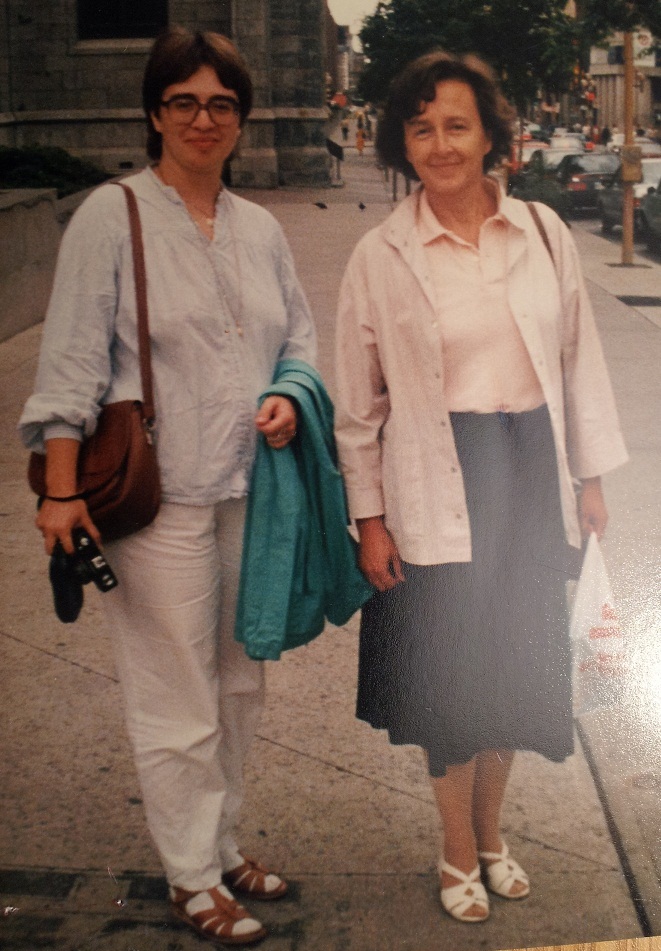
But I have found some pictures from previous conferences.


This is Moscow 1981. I wasn't a member, I was interpreter and guide for the Swedish delegates. At that time, I couldn't even dream of becoming a member, still less the president.


Yet, here I am, two years later, in Bordeaux, giving a paper.


And here I am, in 1985, in Montreal, with Petra Wrede from Finland.

Somewhere in storage I have more pictures, from conferences, Board meetings and crayfish parties. This last one gives you a very good idea of how much fun you can have at a Board meeting: in San Diego, with Carole Scott, John Stephens and Thomas van der Walt.


Saturday, 14 March 2015

Press Replay

This is what I wrote two years ago. There is very little I can add. I am tremendously privileged to have a research leave every seventh term, just about once in two years.

I don't have a book project this time, but I have several large and difficult chapters that I agreed to write long ago in moments of weakness, hoping that something would come in between. As usual, it hasn't, so THE TIME HAS COME. For some inexplicable reason, I am giving three keynote talks at conferences in the nearest future and for two of these I only have a vague idea of what I am doing. All in all, the amount of text I have to generate will add up to a book.Therefore I need to plan carefully.

In the next few weeks I will have to grade last term's papers. I will try to do it as soon as possible to take it off my mind. Doctoral supervision is not affected by research leaves so any moment a draft may land in my computer, anything from a chapter section to a finished thesis. I will deal with it when it comes.

The graduate admissions are almost done for this round, and I don't have to attend meetings. My diary is wonderfully empty except for some dinners with good friends or visits from grandchildren.

Soon it will be warm enough to dig in the garden, and my physiotherapeut has mended my shoulder. I am building a gorgeous dollhouse. Can life get any better?


Saturday, 10 May 2014

More fun with indexing


The index has gone to the publisher and come back as a concordance. This is a new process for me, and it looked clever and helpful – until I started checking what the indexing software had done with my original list. First of all, for some reason, I noticed that “White, Hayden”, whom I only mention once (and one time too many), has got a long row of page numbers. On closer examination, it included fifty shades of white, including White Witch in Narnia.

Henry James and William James were of course brothers, but they are still two separate people with an entry each, while the concordance also suggests a reference to King James the Third (from a counterfactual novel).

For “Wolf, Mark”, “Wolf, Maryanne” and “Wolf, Shelby Ann”, the concordance has picked up Max's wolf suit in Where the Wild Things Are, wolf pack in The Hunger Games and the epomymous character in Emily Gravett's Wolves.

The young adult author Lucy Christopher got references to Christopher Robin, and the critic Jacqueline Rose to Rose, the sister in The Tunnel.

I have a theoretical discussion of animal characters in fiction, but I don't want references to any kind of animal mentioned in passing in text analysis. Likewise, I only have a few pages on representation of society and family, but apparently both words appear in abundance in my book. I should have anticipated it.

And of course the concordance doesn't know that if I discuss a novel on eight pages I probably only mention the title on the first and the last. 


Friday, 25 April 2014

Joys of indexing


I know you won't believe me, but I truly enjoy compiling an index for my books. Most people I know hate it and will pay someone to do it or let the publisher do it. Once, in a tight moment, I asked my publisher to do the index and deduce the costs from my royalties. Of course I had to do it all over again myslef. I am the only one who knows what is important in my book and should go into the index. I am the only one who knows when “dream” is a cognitive process and therefore should go into the index, as opposed to when it is part of a content discussion and therefore shouldn't. I am the only one who knows that “the death of the author” should neither be indexed under death nor author.

Indexing is the first and only stage at which you realise what your book is really about because you see which terms and names pop up on every other page, rather than those in your subheadings. The first and only stage when you notice all small inconsistencies, such as alternating between “dystopian literature” and “dystopian fiction”. When you see that sometimes you provide authors for titles and sometimes you don't, and it will be a hell to index these titles. When you have to admit that some terms and concepts are superfluous because you only mention them once in passing and never explain. When you regret that you have mentioned names in the body of text rather than in in-text references because they quite unnecessarily get a separate index entry. Or the other way round, with the in-text reference only, an important source is not reflected in the index. And so on, infinitely.

Sadly, at this stage it is too late to make any changes. I used to compile the index with the first draft checking for exactly these small stupid details. For some reason, I didn't this time, and now I am punished for my laziness. Of course nobody will notice, because the only reason people use indices is to check whether they are in them and how often. (At least, this is the only reason I use indices in other people's books).

PS In Kurt Vonnegut's Cat's Cradle there is a character who can tell the author's personality from an index. I have no doubts.


Sunday, 22 December 2013

ABC blog: Final reflections

For the whole series, click on the letter
Previous entries, A  B  D  E  F  G  H  I  J  K  L  M  N  O  P  Q  R  S  T  U  V  W  X Y Z  Å  Ä  Ö 


A marathon is a marathon, and it has its advantages and disadvantages. Running like this through forty plus years of my academic career, covering my main areas of interest, noting my achievements and failures, has been gratifying. The format of a blog post is a bit like an encyclopedic entry where you are given two hundred words to cover a subject on which you'd prefer to write a book, or in fact have written a book. But it makes you think carefully. The day-by-day rule implies that I didn't have time to consider my entries. Looking back, I probably would have chosen a different word. But it is the way it is now. I am not going to cheat and edit. And yet, the selection of words really reflects what I am doing or have done, and it was particularly interesting to consider some areas where I haven't done anything for a long time. Shall I revisit Jung or is he completely outdated? Shall I try to resuscitate kenotype or is there no need for this term? Will I ever use syllepsis again?

Of course it is also clear from the entries that certain topics are pervasive: narrative and time and Bakhtin. While five years ago I would not even consider empathy.

I have had some very good responses to this series, so obviously it hasn't just been useful for myself. Thank you for your support, y'all. Several people have suggested that I should publish it as a book, so if there are some publishers out there, I think it is a brilliant idea. With illustrations by Clémentine Beauvais.

Saturday, 21 December 2013

ABC blog: bonus post Ö

Previous entries, A  B  D  E  F  G  H  I  J  K  L  M  N  O  P  Q  R  S  T  U  V  W  X Y Z  Å  Ä

Ö is for översättning, which means translation and which I have totally missed in my T post. But I was a translator before I became a children's literature scholar, and it was translation that brought me to children's literature. I started translating short texts for children from Swedish, and interestingly enough, children's radio wanted fairy tales, while a children's magazine I translated for wanted anything but fairy tales (one of those weird pedagogical twists). And large children's publishers didn't want anything from a beginning translator. I always wanted to translate Astrid Lindgren, but there was already a big fight over her when I joined the club. So my only published book-length translations were not children's literature. And yet my translation practice proved helpful when I did translation studies, because if you don't know how translators work you may sometimes pose very stupid questions about why translators make seemingly inexplicable changes, and why two translations of the same work look so different, and why a poor translation is always longer than the original. By the way, there is no such thing as ”untranslatable”. There are just lazy or less talented translators. Try to translate my ABC blog into your language or a language you know and see what you might need to change. Warning: don't trust Google.

Friday, 20 December 2013

ABC blog: bonus post Ä

Previous entries, A  B  D  E  F  G  H  I  J  K  L  M  N  O  P  Q  R  S  T  U  V  W  X Y Z  Å

 Ä is for äldre which means ”older”, and it is used in Swedish in the phrase äldre barnlitteratur, older children's literature. But what is older? Older than what? I must admit that it took me a long time to get interested in older children's literature, and I still tend to be more involved with ”new” or ”contemporary” which doesn't make much sense either because my contemporary begins in the 1970s and '80s which for most of my students is ancient. I believe that for many children's litrature colleagues older means 17th and 18th century, but I don't know much about it, and it's too late for me to start learning more. The subject here in Cambridge that fascinates me is Medieval and Modern Languages, which, from a children's literature perspective is unfathomable. Which just shows how complex such simple labels as “old” and “new” can be.

Thursday, 19 December 2013

ABC blog, bonus post: Å

For previous entries, click A  B  D  E  F  G  H  I  J  K  L  M  N  O  P  Q  R  S  T  U  V  W  X Y Z

Although I promised that the Z post would be the last, I cannot refrain from bonus posts based on the final letters of the Swedish alphabet. I promise solemnly that I won't continue with Cyrillic, Greek, Hebrew or Futhark, although it is tempting.


Å is for ångest, which in Swedish means ”anxiety” or ”anguish” and is sometimes referred to with its German equivalent ”Angst”. For some reason, English-speaking people, who are generally hostile toward all things alien, love German philosophical terms such as Angst or Dasein. I think it is just translators being lazy.

Anxiety is omnipresent in young adult literature because being an adolescent is one huge uncertainty. Too late to go back to childhood, but not quite adult yet. Although apparently there is a new kind of literature now, NewAdult (NA) literature which, as far as I can see, is devoid of anxiety. 

Wednesday, 18 December 2013

ABC blog: Z

To see previous entries, click A  B  D  E  F  G  H  I  J  K  L  M  N  O  P  Q  R  S  T  U  V  W  X  Y


Z is for zero focalisation. You didn't believe I would find a topic beginning with Z, did you? But I have written a lot on narrative perspective, and zero focalisation is one of the most common narrative devices in children's literature. It is not quite the same as omniscient narration, because focalisation is about seeing rather than speaking. Zero focalisation is a view from nowhere, a vantage point taken by an anonymous agency, and you almost feel guilty spying on somebody's life. Zero focalisation is not a tremendously exiting device because how can you engage with characters if you never share their point of view? It's like watching fish in a fish tank. In practice, it is most often shifting multiple focalisation, when the point of view moves from character to character, sometimes going inside their minds, sometime staying outside.

Z is also for zigzag temporality, when the narrative moves back and forth between two or more moments in story time.

Z is also for zoomorphism, which is a common device in children's literature when humans appear in animal disguise. It is the opposite of anthropomorphism, in which animals are endowed with human traits. You may think it is the same, but it isn't. However, we have now come to the end of the alphabet, and you may need a break.


Tuesday, 17 December 2013

ABC blog: Y

To see previous entries, click A  B  D  E  F  G  H  I  J  K  L  M  N  O  P  Q  R  S  T  U  V  W  X

Y is for young adult. I didn't know much about it before I moved to Sweden because I was mostly interested in fantasy, and at that time fantasy tended to be for younger children. During my first year in Sweden I took a course in young adult fiction. The instructor, who later became my supervisor, had an interesting approach to teaching. She didn't give us required reading for every session, but a list from which we were supposed to read as much as possible. Being an obedient student, I read everything. It was mostly Swedish YA because it was a huge, internationally acknowledged genre, candid and engaging, with explicit sex, violence, drugs, teenage parenthood and everything that children's literature critics today think is new and daring. It wasn't all good literature, and very few books are still in print or even mentioned in textbooks, but it was a large area of study in Sweden in the early 1980s.

After that first course I went on to my thesis on fantasy, but as soon as I started teaching myself, YA became one of my subjects because it was a mandatory course for all secondary teacher trainees. It still had a strong focus on Swedish literature, but you cannot really talk YA without first looking at Huckleberry Finn and Little Women, and of course The Catcher in the Rye is central and has always been one of my favourite books. And then there was Aidan Chambers whose novels my students loved, and when he was in Sweden, which he often was then, I would invite him to give a talk.

In my book From mythic to linear, YA is defined by linearity, when the cyclical time, kairos, opens up, and there is no way back. The age of the protagonist or the reader has nothing to do with it. But, tied to linearity, YA brings in all the questions that a child was spared or pretended not to notice: growing up, sexuality, selfhood, parental revolt, risk taking.

YA today is more interesting and challenging than thirty years ago: not in themes, but in expressive means. It has also abandoned the constraints of everyday realism and branched into many different genres. A wide field for experimental writing, just as risky as adolescence itself.


Monday, 16 December 2013

ABC blog: X

To see previous entries, click A  B  D  E  F  G  H  I  J  K  L  M  N  O  P  Q  R  S  T  U  V  W


X is for xenotopia. Never heard of it? I was going to say, of course not, because I have just made it up, but I googled it to make sure, and it does exist. Although not quite in the sense I have made it up. Xenotopia means Strangeworldiness, so all fiction that utilises Other worlds, Alternative worlds, parallel world, magical worlds, fantastic worlds, alien worlds – all such books are xenotopian. They can be utopian or dystopian or heterotopian or whatever. Of course, all fictional worlds are strange, but let's agree that xenotopia is only about worlds that are really strange, ones that you can never reach, not even through time travel.

Sunday, 15 December 2013

ABC blog: W

To see previous entries, click A  B  D  E  F  G  H  I  J  K  L  M  N  O  P  Q  R  S  T  U  V

W is for work. Not work as opposed to text in reader-oriented semiotics, but work as labour. I was once asked to contribute to a special issue of a journal on work in children's literature, and the main argument of my contribution was that very few children's literature children know what work is. When the issue appeared it was briefly reviewed online, and somebody who had only read the review emailed me in rage, enumerating all the examples of work... that I examined in my article. They didn't, however, mention the very best: Tom Sawyer whitewashing the fence, where Mark Twain explains the difference between work and play better than anyone.

Work is not an exciting action in a story because is it monotonous and repetitive, and unless the text really needs to emphasise how monotonous, repetitive and exhausting it is, it may just mention that it took thirty years to build a city or three hours to hem a dress, but it won't describe every brick and every stitch, because it is boring. Most classical children's literature children are privileged middle class children and don't have to work. Even when they are poor they still have servants to do menial work. Today's children's literature children don't have to work because they go to school. There are many exceptions which I pointed out in my article that my opponent criticised without having read it.

W is also for witches and wizards, abundant in the kind of literature I have written extensively about, and mind, they had been around long before Hogwarts was invented.


Saturday, 14 December 2013

ABC blog: V

To see previous entries, click A  B  D  E  F  G  H  I  J  K  L  M  N  O  P  Q  R  S  T  U

V is for ventriloquism. I am amazed at myself that I have never used the concept in my studies! It should be the most fundamental notion in children's literature research: adult author pretending that somebody else is speaking. That we hear an authentic voice – another V – of a child.

The way I have put it sounds horrible, an unpardonable exercise of power, and, sadly, this is often the case. However, if we look at it positively, a children's author can give a voice to someone who is otherwise silenced, as children frequently are: seen, but not heard. A first-person child narrator is not always the best solution: the child may not have the vocabulary and the cognitive capacity to account for their experience. Ventriloquism may then work to express the child experience through the prism of an adult. Hard, next to impossible, but this is what the best children's writers do.

Friday, 13 December 2013

ABC blog: U

To see previous entries, click A  B  D  E  F  G  H  I  J  K  L  M  N  O  P  Q  R  S  T


U is for underdog. Why do we always align with the weak, the oppressed, the underprivileged, the unjustly treated? Actually, we don't, but the texts make us to. It would be much easier to bet on the strong, rich and beautiful, but where would the story go from there? Only downhill, and we don't want that. Or if we do, we are aware that we are reading or watching a tragedy. Children's literature is seldom, if ever, a tragedy, even if it is dark and full of sorrow, because the child can recuperate by virtue of being a child. There may be setbacks, there may be hardships and suffering, but there will always be a promise.

A child is an underdog by definition, like the younger brother or sister in a folktale. The hero must start at a low point to climb. And while we always know that they will make it, the question is how, and will they have to sacrifice something, and will they keep their integrity, and will we still like them when they get there.

U is also for utopia, but I have already discussed it in other entries.

Thursday, 12 December 2013

ABC blog: T

To see previous entries, click A  B  D  E  F  G  H  I  J  K  L  M  N  O  P  Q  R  S

T is for time. You know, “parsley, sage, rosemary and time”. A time to be born and a time to die. The time garden. A wrinkle in time. A stitch in time. Time cat. A traveller in time. The tale of time city. Bedtime for Frances. Time to get out of the bath, Shirley. I have written about them all. And some more that do not have the word “time” in the title.

I had a chapter on time displacement in my thesis, but I don't think I did anything revolutionary, just categorised time-related fantasemes. 

I wrote a book the initial title of which was “Time and archaic thought in children's literature”, but the marketing people said it wouldn't sell so it was changed to From mythic to linear: Time in children's literature. It is my favourite book, and I am a bit upset that it hasn't been noticed more because I am doing something that hasn't been done elsewhere. I look at the way time is presented in children's books, old and new, realistic and fantastic. I look at two kinds of time: chronos, the measurable time, and kairos, the mythical, sacred time, and how children's literature systematically utilises the latter to portray the condition of childhood. The idea of kairos and chronos comes from the myth and religion scholar Mircea Eliade, and it complements in a fascinating way Bakhtin's carnival, since the suspended carnivalesque time is of course kairos, but you cannot stay there forever. 


Wednesday, 11 December 2013

ABC blog: S

To see previous entries, click A  B  D  E  F  G  H  I  J  K  L  M  N  O  P  Q  R

S is for syllepsis. It is one of many terms that I had to invent when we wrote How Picturebooks Work. Every time we encountered something we needed a name for I would invent it, much to my co-author's irritation because she thought we had too many fancy words in our book already. But structuralists love labels, and we needed a label to put on side narratives in picturebooks, not mentioned by words, which either are completely independent of the main narrative or reflects it in some way. Jane Doonan calls them running stories, but I felt it was a bit awkward as a term. Genette uses syllepsis for an independent narrative, although of course he had never seen a picturebook. (Just imagine how much more interesting his study of paratexts might have been!) One of the great masters of syllepsis is the Swedish picturebook maker Sven Nordqvist, the author of Pettson and Findus (aka Festus and Mercury, for an inexplicable reason). He always has some weird creatures in the foreground that live a life of their own, oblivious of the main characters and their doings. But if you don't pay attention to the sylleptic narrative you miss half the fun. Or, in some picturebooks, almost all the fun.

S is also for sequel. I have considerable issues with the terms sequel and series which many colleagues and students use interchangeably. While I see no point in having two different terms for the same thing, I feel it imperative to have two separate terms for two distinct phenomena. A sequel is a narrative that continues from where the previous narrative stopped. There may be as many sequels as you like, but as long as they have some kind of temporal sequence and progression that's what they are. Serial fiction, or series, indicates a set of books without temporal relationship. The characters never grow up, and all their adventures cannot possibly be squeezed into their summer holidays without poetic licence. You can read series in any order, but you need to read sequels in a particular order, although it doesn't have to be chronological within the story (the author may have a reason to include a flashback). Now, I know everybody will still call Harry Potter and The Hunger Games series, but I have made myself clear on the matter. 


Ill. Sven Nordqvist

Tuesday, 10 December 2013

ABC blog: R

To see previous entries, click A  B  D  E  F  G  H  I  J  K  L  M  N  O  P  Q

R is for reader. For someone working with literature I have been remarkably indifferent toward readers until recently. For a structuralist, as I believed I was, readers are of no interest. Also, because children's literature research is obsessed with readers, I very deliberately avoided them. Until I discovered that readers can be implied which immediately made them more tolerable.

An implied reader is a set of qualifications that a text presupposes. It means that the text requires certain knowledge, experience, competence, context and other qualities that make it accessible. Implied readers have also been called inscribed readers, model readers, ideal readers, hypothetical readers and virtual readers. There may be some subtle difference between these terms, but I haven't discovered them yet or found the distinction necessary. Very few real readers, if any, coincide with the implied reader, but this agency is helpful to consider what the text asks real readers to do and what it believes real readers are or should be capable of doing.

I got seriously interested in readers when I moved to Education and decided that, while I am here, I can just as well learn something about readers. Not real readers – still cannot endure them – but just as I had previously studied the (implied) author/narrator side of the communication chain within the text, I now moved to the other pole. And it turned out quite interesting as well, especially after I discovered cognitive criticism that explores what texts afford in terms of reader engagement. Maybe one day I will feel grown-up enough to venture out among real readers and do some experimental work, but on the other hand, that's what you have research assistants for. 

Ill. Eva Billow


Monday, 9 December 2013

ABC blog: Q

To see previous entries, click A  B  D  E  F  G  H  I  J  K  L  M  N  O  P

Q is for queer. It has been a fashionable word for a while. Some of my students had been using it extensively before I decided to find out what it meant. You know, one day everything is liminal, next day everything is queer, and you have no time to catch up. I have repeatedly stated that for me a theory that is only valid for a limited range of texts is of less interest. If queer theory was only applicable to discuss gender identity I would probably not have delved any deeper into it. Some rigid versions of feminist theory try to replace one dominance by another. Queer theory is inclusive: plurality rather than positive discrimination. A children's book cannot replace adult hegemony by a child one; yet it is possible to address childhood and adulthood as equally valuable. At least in theory.

I published my first article on the subject, titled “Pippi, queer and carnival”, in 2003 in a non-children's literature journal. I then tested it in several talks, including my Grimm Award acceptance speech in 2005. It was finally developed into a book, Power, Voice and Subjectivity in Literature for Young People, where aetonormativity was launched.

Q is also for quest, a popular, not to say omnipresent motif in children's literature. 

Ill. Ingrid Vang Nyman
 

Sunday, 8 December 2013

ABC blog: P

To see previous entries, click A  B  D  E  F  G  H  I  J  K  L  M  N  O

P is for post-. As in postmodern, which is the most abused word in literary criticism. When my students use it, I ask them whether they mean complex and interesting, and if yes, just say so. There are some distinct features of postmodernism which I have explored, and it can be a good practical tool, but if it includes almost anything, there is no point. Postcolonial, posthuman and other posts must also be defined before you can make them useful.

P is also for pre-, as in prelapsarian.

P is for pro-, as in prolepsis.

P is for para-, as in paratext.

P is for proto-, as in proto-children's literature, which is what children read before there was any children's literature.

P is also for pastoral, which is one of the most common topoi of conventional children's literature.

P is for Peter Pan complex, the reluctance to grow up, which is one of children's literature's foremost paradoxes: adult writers want the child to stay young forever, but know it's impossible. Thus, the impossibility of children's literature, as Jacqueline Rose would have it. Fortunately, children's writers don't read Rose so, like the bumblebee, they don't know it's impossible. Yet the posthuman Peter Pan in his prelapsarian pastoral is for many the epitome of children's literature. 

P is also for my favourite children's book. 


Saturday, 7 December 2013

ABC blog: O

To see previous entries, click A  B  D  E  F  G  H  I  J  K  L  M  N
 
O is for orphan, the central character of children's literature. Like almost everything in children’s literature, orphans can be traced back to myths and folktales, in which the symbolic removal of parental figures is the foremost requirement for a successful rite of passage. A children's literature child is an orphan by definition, whether actual or symbolic. As long as the child is under parental protection, nothing interesting can happen. So the first duty of a children's literature parent is to be absent, preferably dead, but temporary absent will do. Even just emotionally absent will do.

If you browse mentally through children's books you know, all characters are orphaned in some way or other. A socio-historical scholar would say that the abundance of orphans in early children's literature reflected mortality rates in society, and I would ask: so why are there still so many orphans in children's books today, disproportionally many? Because, says my non-mimetic critical self, literature is not a direct reflection of reality, but a distorting mirror.

O is also for omission, which is one of the most fascinating narrative devices. Omission of parents must have a very good reason. Did the little prince ever have a mum and a dad?