Sunday, 11 April 2010
Vacations are for students, not for teachers
Today is the last day of my so-called off-term time, aka research period. Don't even try to call it a break or still less vacation. A friend of mine, a university teacher, used to quote her Head of Department: "Vacations are for students, not fore teachers", Indeed, off-term time is a busy period. Firstly, there are essays to mark, and as there are twice as many essays to mark as you supervise... well, that's the way it is. Then there are moderations, cross-moderations, super-moderations, hyper-moderations and all that. Just when you think it's all over, an email comes, marked URGENT, asking for additional reference letters for our students who are applying for doctoral studies. And then there are grant applications and tons of other routine work that you are trying to catch up with. So I haven't had much time for research. And tomorrow the pre-term week starts, meaning meetings, meetings and more meetings. So I am looking forward to summer vacations - sorry, research period.

Saturday, 10 April 2010
Recap
It's a year since we moved into this house. (Staffan says it's a year and a day, but I am not that particular). Almost every day we say to each other how lucky we are to have found it. It just feels right.
A lot has happened during this year, apart from the house, but that's another story. I am just looking back at the year in the house. We have redecorated the kitchen and are doing the large bathroom soon. The pink walls in the dining room, that I thought would be the first thing I'd paint, are still pink, but we now call it peach and think it's quite nice. We haven't put up our lamps, and the paintings I put up temporarily are still where I put them. I haven't changed the curtains although I must soon because in some rooms they are literally falling apart. All the furniture is exactly where we placed in from start.
What has changed most is the garden. When I first saw the garden and fell in love with it I thougt it was perfect. I should have remembered that nobody is perfect, and a garden least of all. I am still discovering things in the garden. The other day, I found a rusted barbecue grill inside a shrub. It fell into crumbs when I tried to move it. I am still fighting brambles and ivy, but I know what is weeds and what is flowers. This morning we saw a woodpecker. We are so lucky to have found this house.
A lot has happened during this year, apart from the house, but that's another story. I am just looking back at the year in the house. We have redecorated the kitchen and are doing the large bathroom soon. The pink walls in the dining room, that I thought would be the first thing I'd paint, are still pink, but we now call it peach and think it's quite nice. We haven't put up our lamps, and the paintings I put up temporarily are still where I put them. I haven't changed the curtains although I must soon because in some rooms they are literally falling apart. All the furniture is exactly where we placed in from start.
What has changed most is the garden. When I first saw the garden and fell in love with it I thougt it was perfect. I should have remembered that nobody is perfect, and a garden least of all. I am still discovering things in the garden. The other day, I found a rusted barbecue grill inside a shrub. It fell into crumbs when I tried to move it. I am still fighting brambles and ivy, but I know what is weeds and what is flowers. This morning we saw a woodpecker. We are so lucky to have found this house.
Thursday, 8 April 2010
Going green
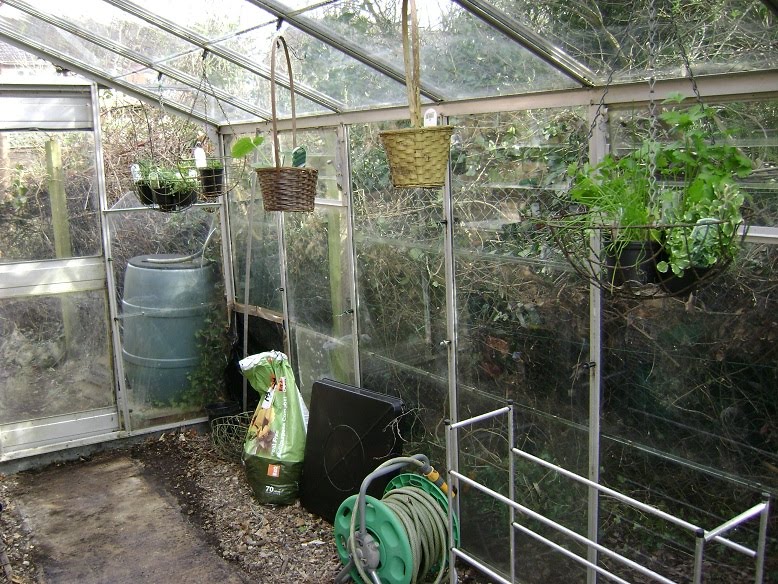
As a contrast to my previous post: since the longest winter in my life (or so it feels) is eventually over, I take every opportunity to be in the garden. And when I am not in the garden I am in my greenhouse. I would have never thought of having a greenhouse if it hadn't been there already. It came as a bonus with the house - one of many things we didn't know we wanted. A year ago when we moved in you could hardly see the greenhouse, it was all overgrown with ivy and brambles and weeds. I cleaned it up a bit last autumn, but there is little incentive to put a lot of effort in a toy you cannot play with at once. So I used it mostly as a toolshed. But now... The thing is, I've never had a greenhouse and have no idea what to do. You see all those pretty pictures in magazines and on websites, yet here I am, with a greenhouse and all kinds of equipment for it and no idea how to use it. So I was very proud of myself when I figured out how to hang baskets on small pegs. Since I took this photo I have added two full trays of vegies and strawberries. No wonder I think that marking essays takes too much time!
Meta-moderation
It's marking time again, and I have been given a new task. Cross-course moderation. Now, don't misunderstand me, I do think students should have fair treatment, and grades should be justified, but are all these multiple processes really, really necessary? Each essay is marked by two independent markers; if they give different grades, even slightly different, they have to moderate and agree. If they absolutely don't agree, the essay goes to a third marker. Fool-proof, you would say. No, not quite. Cross-course moderation means you are given a number of essays from another course, preferably one excellent, one average and one on the edge of fail. My assignment as cross-moderator is to read the essays and the markers' comments and decide, firstly, whether the grade is fair, and secondly, whether the comments are helpful. The comments are supposed to be formative. I actually like the idea. The student can learn a lot from good comments, just as you can learn a lot from a good peer review of your article. Unfortunately, they are not always good. What I do, then, is write comments on comments. Meta-comments.
Note that the essays will then go further to external examiners and after that to the examination board. They take things seriously here in Cantabrigia.
Note that the essays will then go further to external examiners and after that to the examination board. They take things seriously here in Cantabrigia.
Sunday, 7 March 2010
The value of hobbies
Whenever I feel exhausted to the degree that I cannot even read, I escape to my new Tudor dollhouse. I've made lots of improvements: painted it both outside and inside, put in half-timbering, roofing, window shutters and latticed wondow panes (the latter I have learned to make from the net in which you buy your oranges). The joys of making a period house is learning all about the period. What colour should the outside walls be? A little folder from Lavenham is helpful.
 Tudor kitchen tables were made of trestles with boards on them, not fixed so that they could be put away when not used. They had holes to hang on hooks on the wall. Masters would put notices on the board for the servants - hence, notice board. The trestles came in many shapes, such as the comb trestle, which is what I have made. I can soon sit an exam on the Tudor period. (Two weeks ago I had no idea what a trestle was, still less a comb trestle).
My most recent discovery concerns dogs. I want a dog by the fireplace in my grand hall, but how do I find out what breeds were to be found in the Tudor time?
 Tudor kitchen tables were made of trestles with boards on them, not fixed so that they could be put away when not used. They had holes to hang on hooks on the wall. Masters would put notices on the board for the servants - hence, notice board. The trestles came in many shapes, such as the comb trestle, which is what I have made. I can soon sit an exam on the Tudor period. (Two weeks ago I had no idea what a trestle was, still less a comb trestle).
My most recent discovery concerns dogs. I want a dog by the fireplace in my grand hall, but how do I find out what breeds were to be found in the Tudor time?
Naturalisation
Our process of naturalisation is primarily connected to material objects. For instance, my new computer has a British plug. We will be fully naturalised when all our appliances have British plugs. I wonder how many years it takes. How often do you buy a new hair dryer or electic toothbrush?
Staffan has just taken another radical step toward naturalisation. His car has now a British speedometer.
Staffan has just taken another radical step toward naturalisation. His car has now a British speedometer.
Viva!
I have certainly learned enough about academic life here not to be surprised by anything, but it is still inetresting to note the differences. In the old country, when a PhD student chooses a topic it will be discussed with the supervisor and then registered at the department. At some point, the student will present the research plan at a seminar and get feedback from fellow students. Here, the poor soul has to write a 20.000-word report and go through a "viva", which means face-to-face interrogation by two examiners. The supervisor is allowed to sit in and keep her mouth shut. It is hard if the student is obviously giving a totally wrong answer and you boil inside saying mutely: "Haven't we discussed this ten times???". Anyway, my first student has just gone through this, and the examiners were very nice, and most of their questions were anticipated, and most of the comments valuable and formative. For me it was just as much a rite of passage as for the student.
Subscribe to:
Posts (Atom)