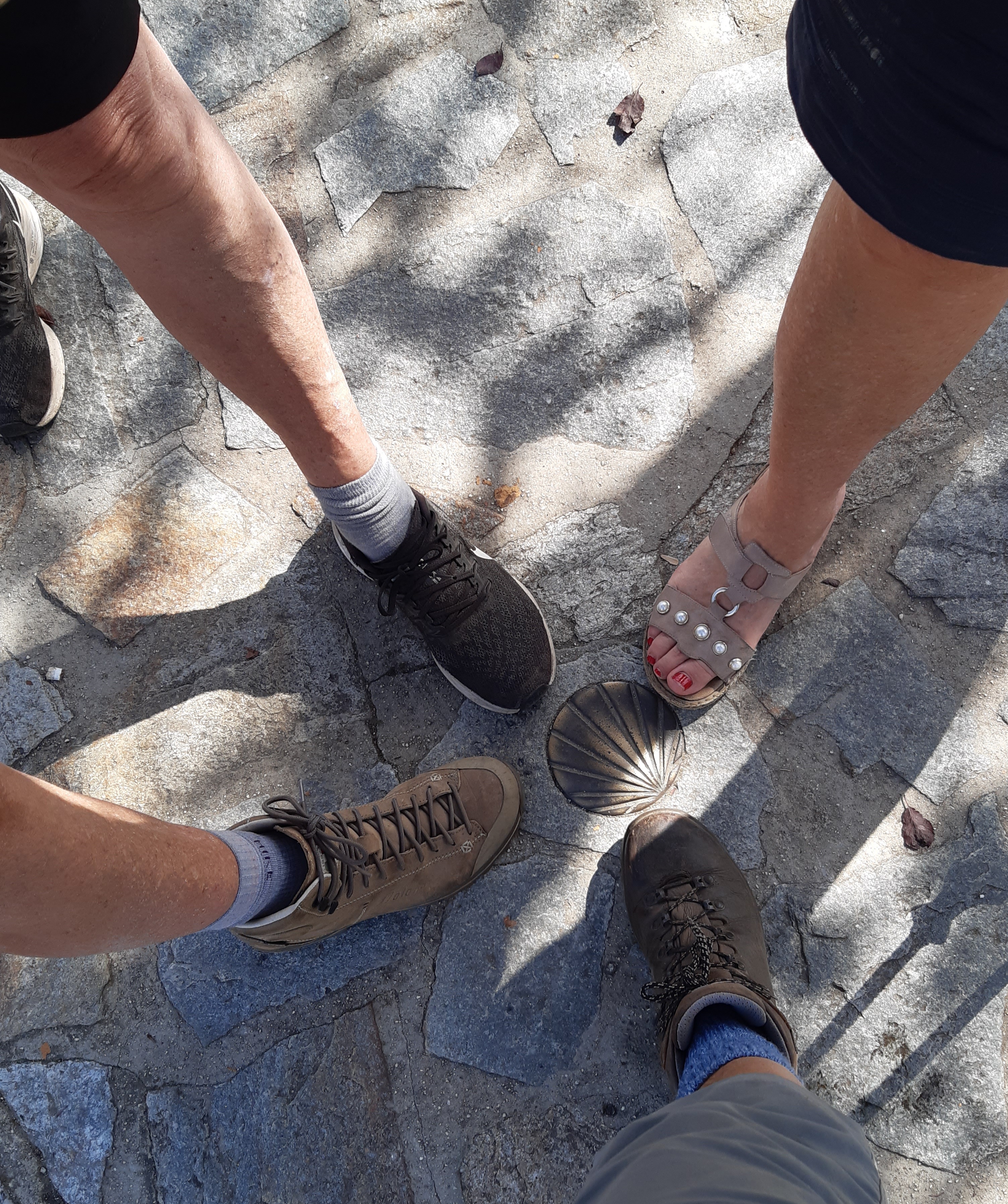
Read the first and second part of this story.
As
already mentioned, I kept asking myself what I was expecting, what I
was seeking. In the film, The
Way,
as the four pilgrims receive their Compostela, they are asked why
they did the pilgrimage, and they all have various reasons. The main
character does it for his son who died in an accident on Camino.
Sarah
has
pledged to give up smoking. Joost wants to lose weight because his
wife won’t sleep with him. And Jack is struggling with writer’s
block. Both before and during the walk I was considering what my
answer would be. I did it because I like walking – no, not strong
enough; I can walk around Stockholm or anyway in Sweden. Because this
walk has a special status, whether you have a faith or not; because
thousands upon thousands of people have done it for a thousand years,
and I wanted to sense their spirit lingering in the stones. Because I
am a pathetically goal-oriented person and want another certificate
of achievement to frame and put up on my wall. Or actually because I
had just gone through a traumatic period in my life, losing my
partner of forty years; because I needed to figure out, far away from
everything, what was important in the remaining years, months or
weeks, what mattered, what made life worth living. In short, I was
seeking some kind of epiphany, not a religious awakening,
not
a voice from above, but some clarity of thought.
I
don’t know what my companions were seeking. I saw Annika in deep
prayer a few times, which
made me a bit envious, and
I happen to know Christina had
a mission, but we didn’t discuss our purpose or our expectations.
We met many people on the road, and although I am always shy to
strike up a conversation, occasionally I said: Do you mind my asking,
please don’t feel obliged to reply: why are you doing this? Some
people simply said it was a fantastic experience, which is a good
reason. We met an Irish Catholic priest, and there seemed no need to
ask what he was doing there.
We met a Frenchman who had done it many times, along different
trails. We
met some Swedes. We met Canadians. Quite a few people we kept meeting
day after day. Most
people who have walked Camino say meeting other pilgrims was half the
pleasure.

At
one point when a couple passed by us I heard them speak Russian so I
said Счастливого
пути! and
of course they stopped, and we walked together for a while. The woman confided in me; she didn't want her partner to hear. They were very fast walkers, doing
30-40 km a day, so they left us quickly after.
My
companions and I had agreed from start, all the way back when were
arranging the trip, that we would each walk at our pace, that we
didn’t have to stay together, and that we didn’t want to chat. As
it happened, we did stay together most of the time, and we had brief
chats when any two of us walked side by side, and of course we
chatted during our coffee and lunch breaks, but otherwise we walked
silently, each immersed in our own thoughts.
Actually,
at least for me, on a long-distance walk there is little room for
thoughts. Partly because you need to watch where you are going, and
particularly by the end of an arduous day you are simply preoccupied
with putting one foot in front of the other. Partly because walking
is the most perfect way to clean your mind, to get rid of everything
that bothers you, until your only thought, like a mantra, is: I am
here. Being in nature, walking slowly and paying attention is the
attraction for me. We stopped often to take pictures, and while we
stood in the same spot our pictures were probably quite different. We
would point out some interesting feature for each other, but
otherwise let the others make their own discoveries.

As
I walked there, hour after hour of uninterrupted silence, except for
bird song and wind in the eucalyptus trees, I continued asking myself
what I was doing there and whether it was enough to say I was doing
it for great experience, but it didn’t feel enough. Every now and
then I recited Joseph Brodsky’s poem ”Pilgrims” for myself, as
a kind of secular prayer, trying to invoke something both hazy and
powerful, something that all those thousands
upon thousands of people who had walked and were walking felt,
something that I was guessing my companions felt. In the evenings we
agreed that the day was wonderful, but didn’t go into detail.
While
the awaited epiphany didn’t arrive, I clearly felt a change in my
perception of the world and of my life. Somehow everything beyond
Camino, everything back home felt petty, insignificant. It is quite
common that as you travel your ordinary life fades away, and
conversely, after you get home your travel experience, no matter how
overwhelming, is eventually stored away in your emotional memory. I
knew it would happen when I got home, and it did. Yet when I was
there, nothing was more important than being there, and after a
couple of days I stopped asking myself what I was doing. As we
started walking at the crack of dawn on the final morning I stated calmly that it was my
last chance to get the Answer.

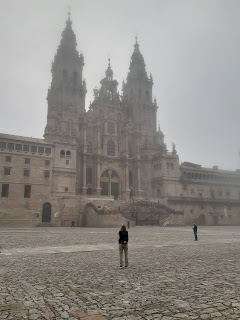
There
we were, on the square in front of the cathedral, together with
hundreds of other pilgrims, and I felt absolutely nothing, apart from
being exhausted and hungry. I could sense similar vibes from my
companions. We went to our hotel which turned out to be an old
monastery or seminary, with cloisters and long stone-clad corridors,
and we got our rooms that looked like premium monk cells with iron
beds.
After a short rest we went out to celebrate. On the way back we
stayed a while on the square, admiring the cathedral bathing in
light, under a full moon (there is always a full moon in movies to
emphasise dramatic moments; I swear there was a full moon).
In
the morning we had breakfast in the refectory with valved ceiling,
among dozens of other pilgrims, and you could just about imagine that
there was a monk
in the pulpet in the middle, reading suitable texts to keep us
focused. It was a good start of our final day.
Our first mission was
to get our Compostelas, and we went to the pilgrim office, which was
a disappointment. We were not asked why we had done the walk. We
filled an online questionnaire, submitted our pilgrim passes full of
stamps, paid three euros and received a beautiful document with our
name on it. The moment lacked solemnity. I guess it’s inevitable
given the scale. We learned that on that weekend 8,000 pilgrims
arrived in Santiago. Issuing Compostelas was computerised and
efficient. Of course we were still happy and proud and took pictures. (The second document, by the way, is the certificate of distance, stating that I have walked 120 km from Vilalba to Santiago. Unlike the Compostela, it is written in Spanish).

Our
second task was to get tickets for the Holy Door. Again, in the movie
the pilgrims arrive and approach the cathedral door – you are
encouraged to do it on your knees, but that’s not mandatory –
walk in, put their palm into the palm imprint on the pillar and
supposedly feel something tremendous. The door was closed, and we
were told we needed tickets for particular slots, but we couldn’t
get any sensible information about where to buy those tickets. We
were going to midday pilgrims’ Mass, and before that we had to
check out, and Christina was the only one who persisted – and
succeeded! We split, and I went early, but at half past eleven the
cathedral was already full – what had I expected? I managed to find
a narrow stone
step
by a pillar and texted my companions where I was; they found me and
sat on the floor.
I
am well familiar with Catholic mass so it was easy to follow, but the
sermon was in
Spanish, far
too long and tied to some local event, and I was getting bored and
disappointed. Then came a very efficient eucharist, given the huge
crowds in the cathedral, and that immediately felt better as a
confirmation of togetherness (well, that’s what communion means.
Note that I don’t believe in transubstantiation). And then! Then I
realised that the best part was still coming, the part I had been
waiting for and thought wasn’t coming at all, the part I saw in the
movie and wasn’t sure really existed. There were eight men in
purple cloaks.

The botafumeiro,
the gigantic incense vessel, started swaying, pulled by the eight
men, and where we were sitting it rose just over our heads, higher
and higher, up to the ceiling, and that was the moment when I felt I
was in the right place, that was what I had come for. No epiphany, no
religious awakening, but a deep spiritual experience that I shared
with three people who had become close friends, as well as all the
people I didn’t know at all but who were there for whatever
purpose; and thousands upon thousands of pilgrims in the past
thousand years. It was truly sublime. Many people took pictures and videos, but I just wanted to be in the middle of it. As we rose to go, I got us four
together in a big hug.
After
that, going to see the Portico was an anticlimax, and when we finally
found the palm imprint we were not allowed to touch it.
Following late lunch we decided to separate and stroll around on our own. I think we
all needed some private time after the experience. I didn’t have
any particular wishes, and unfortunately I discovered too late that
there was a guided cathedral roof tour: all slots were booked. I went around
inside the cathedral looking and taking pictures of less prominent
features. Some side chapels were even more beautiful than the main
altar. I went to the cathedral museum which wasn’t very
interesting. I bought a bar of local chocolate. I sat on the square
watching people.
Then
it was time to get back to the hotel from where a limo would take us
to the airport hotel we were staying at for the night. Brief exchange
of experience, nothing profound.
The
trip home was uneventful for some of us and dramatic for others. But
that’s another story.
I
know it will take me a long time to fully understand what I have
lived
through
and what the consequences might be. Just as home felt remote from
Camino so does Camino feel far, far away in both space and time.
While there, I was in an emotional bubble, cozy and protected, free
of responsibilities other than walking on. Right now my feelings
oscillate between: I want to do it again and walk the whole way, and:
I have done it, I don’t have to do it ever again.
Would
I recommend it to a friend? (A TripAdvisor kind of question). It’s
certainly not for everyone. The movie is based on poetic licence: no
one can walk Camino without proper training. The protagonist would
have got bleeding blisters on the first day and would have been
unable to walk at all for the next week or two. That is, unless he
had a heart attack at the first steep ascent and dropped dead. So if
you intend to do the walk, make sure you are physically fit. Travel
agents offer excellent free self-taught training programmes. But even
if you are well trained and walk 15-20 km a week, as I do, it doesn’t
mean Camino is for you. It is a very special kind of pursuit. I have
in my account mentioned some reasons people do it, and I have shared
my own thoughts. One thing I can definitely advise. Don’t say: ”I
have always dreamed of doing it, one day maybe…” If you want to
do it, do it now!
The End